Future fuels A to Z – 19 best picks on future marine fuel technology

The 19 best picks on marine future fuel technology to help you comply with regulations, save money and hit your decarbonisation targets in a handy A-Z.

Read article

Wärtsilä Marine leads the industry in its journey towards a decarbonised and sustainable future. Our portfolio of engines, propulsion systems, hybrid technology and integrated powertrain systems deliver the reliability, safety, and environmental performance to decarbonise the worlds fleet. We offer our customers performance-based agreements, lifecycle solutions, and an unrivalled global network of maritime expertise.

Articles

16 Dec 2025 · Article
5 min read
Short sea shipping and sustainability: 3 interesting considerations
Could an aging fleet and tightening environmental regulations be an opportunity...
MV Afros installed with 4 Anemoi Rotor Sails
11 Dec 2025 · Article
7 min read
Wind-assisted propulsion for ships: 8 helpful things every ship owner should know
Wind power is making a comeback – but with a modern, high-tech...
View from bridge from Harmony of the Seas
3 Dec 2025 · Article
6 min read
From big data to lifecycle optimisation – 4 trends that will affect shipping in 2026
Take a deep dive into four trends and technologies that our...
3D illustration of offshore vessels and rigs
18 Sep 2025 · Article
7 min read
Make more from offshore: how to turn three challenges into opportunities
Want to make more from offshore, with maximised safety and manoeuvrability,...
Bow of TT-Line's MS Robin Hood
17 Jul 2025 · Article
5 min read
3 unexpected AI-powered strategies for improving your vessel efficiency
AI hype is everywhere, and the maritime industry is no exception. How can...
Ammonia as fuel by Wärtsilä
7 Jul 2025 · Article
10 min read
Ammonia as marine fuel? Benefits, challenges, and smart adoption
Adopting ammonia to fuel ships can decrease greenhouse gas emissions. How will it...
Wärtsilä service employee at work
24 Jun 2025 · Article
5 min read
12 amazingly simple ways to slash ship maintenance costs
Ship maintenance can be costly and time-consuming for owners and operators. To make it...
Engine room on Allure of the seas
18 Jun 2025 · Article
5 min read
How to protect ship crews from the biggest cause of engine room fires
Two out of three ship fires start in the engine room. What are the 4 top steps...
Rendering of a ship with electric propulsion from Wärtsilä
6 Jun 2025 · Article
5 min read
Four successful ways to electrify mechanical propulsion – from basic to brilliant
If your vessel uses mechanical propulsion, there are four proven...

Webinars

3D rendering of a vessel with Carbon Capture and Storage
28 May 2025 · Webinar
Get a competitive edge with these 3 tips on onboard carbon capture
Experience our online event and get the insights of carbon capture!
Container vessel animation
25 Feb 2025 · Webinar
How advanced digital twins and AI help optimise vessel performance
Watch our insightful webinar where industry experts reveal how AI and digital...
Three simple ways that data and AI can save you money in vessel operations
20 Nov 2024 · Webinar
Three simple ways that data and AI can save you money in vessel operations
Watch this insightful webinar where industry experts reveal three...
Methanol 32 with engineers
24 Oct 2024 · Webinar
Cyber requirements: how to meet them with the power of type approvals
Watch this interesting webinar and you will learn more about the cyber type...
17 Jan 2024 · Webinar
New methanol engines: how will they power the future?
Watch this interesting webinar and you will learn how the new methanol engines will power the...
14 Nov 2023 · Webinar
Tech Talk - What does the future hold for small merchant vessels?
Follow a fascinating panel debate! You will get insight that helps you develop...
Cargo ship at sea
25 Oct 2023 · Webinar
How to reduce methane slip – winning tactics for your maritime business
Watch this interesting webinar and you will learn how to reduce methane slip...
Container ships at sea
5 Oct 2023 · Webinar
Real-world solutions for the Greek and Cypriot merchant fleet
This webinar will focus on real-world concepts that can help, from future fuels,...
17 Jan 2023 · Webinar
Carbon Intensity Indicator (CII) – Data tools to help you improve your fleet’s CII ratings
Building resilient maritime education in 2022 and...

Whitepapers

propeller flow analysis, where the colored lines or contours represent the velocity and path of the fluid
White paper
36 pages
Insider’s guide to ship propulsion: 8 tips to help you make the right choices
Download this eGuide and learn how to choose propulsion solutions to...
White paper
24 pages
Offshore gains: How to tackle three challenges and sharpen your edge
Perfect for offshore vessel owners and designers. Learn how to boost efficiency...
Wärtsilä employee testing equipment
White paper
32 pages
eGuide: Expert advice: How to deal safely with ammonia on board ships
This safety essentials eGuide draws from Wärtsilä’s experience in ammonia as...
Wärtsilä service employee at work
White paper
20 pages
White paper: How to make the best maintenance plan for your ship – the simple way
Proper planning is the key to a successful maintenance or overhaul...
Aerial top view Tug boat drag container ship to sea port for unloading container
White paper
28 pages
White paper: How to solve the top 4 problems everyone has in merchant shipping operations
Four burning problems are common to every merchant...
high speed Seajet passenger vessel leaving port of Piraeus to Aegean Cycladic island destination
White paper
20 pages
White paper: How to spend less on ship fuel and make amazing savings every sailing
How to cut operational costs? How to meet the tightening...

Case studies

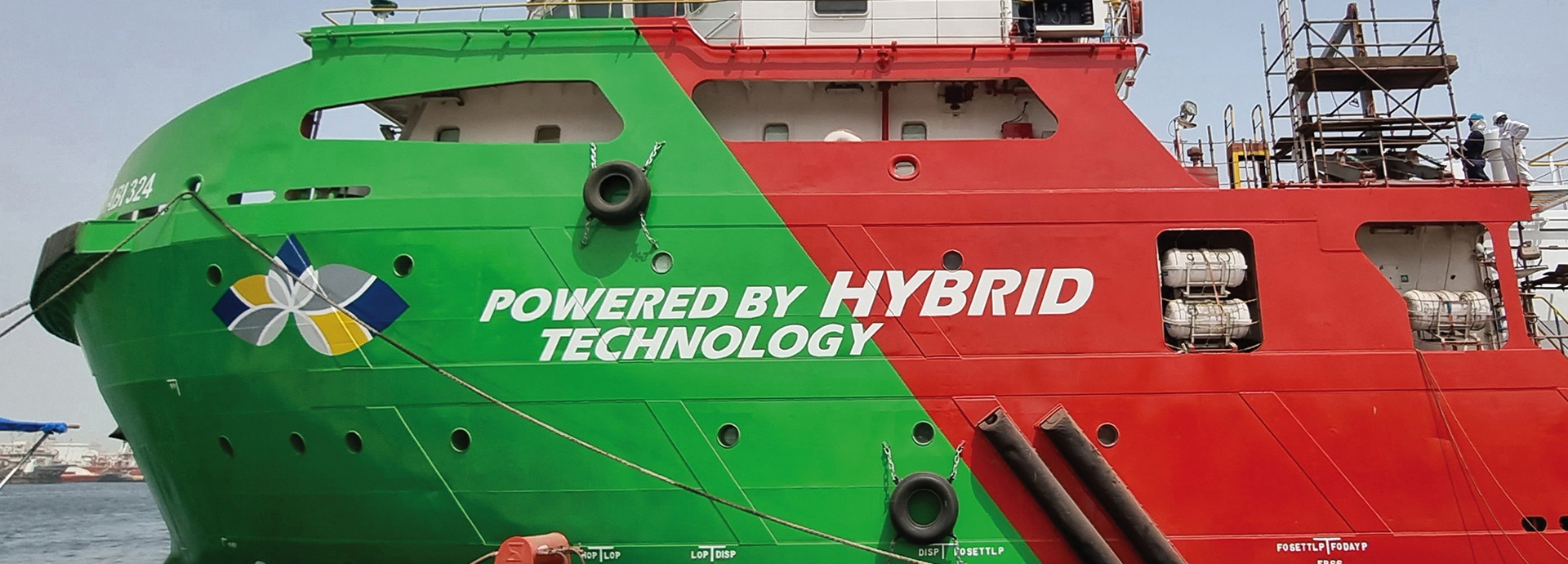
Rawabi goes hybrid

A hybrid retrofit with engines and batteries cut emissions and operating costs and optimised engine operation for the Rawabi 324 anchor handling vessel.

Rawabi goes hybrid to cut emissions and costs

  • Challenge: Reduce emissions and running costs for a key anchor handling tug supply (AHTS) vessel.
  • Solution: Wärtsilä hybrid retrofit combining conventional engine gensets and batteries.
  • Benefit: Lower emissions, optimal engine operation and reduced operating costs.

Going hybrid with a retrofit for one of its key vessels in the Arabian Gulf has helped Rawabi Vallianz Offshore Services (RVOS) save on emissions and running costs. How does the vessel make the most of its battery-engine combo? Why was hybrid operation a great choice for this regional pioneer? Read on to find out.

The challenge: reduce emissions and running costs

Rawabi Vallianz Offshore Services (RVOS) is an ambitious organisation with the goal to become the leading offshore support services provider in its region. Its new fleet includes the Rawabi 324, an anchor handling tug supply vessel operating in the Arabian Gulf. The vessel takes part in anchor handling, rig-move and platform supply operations as well as firefighting and safety standby tasks. RVOS wanted to cut emissions, reduce fuel consumption and minimise maintenance costs on the vessel, while optimising performance.

The solution: a Wärtsilä hybrid retrofit

To meet these goals, RVOS worked with Wärtsilä to retrofit the Rawabi 324 with a hybrid power system that combines a conventional engine and batteries. Rawabi’s ESG guidelines encourage the company to use environmentally friendly solutions, and hybridisation is a perfect match with this aim. Rawabi chose Wärtsilä because of the company’s experience with hybrid retrofits, as Ahmed AlQadeeb, Vice President, Oilfield Services at Rawabi explains: “Wärtsilä can deliver a solid engineering solution, and we know we can trust the quality.”

The Wärtsilä hybrid system is designed to optimise the overall operation of the vessel. It cuts fuel consumption and maintenance costs, and significantly reduces exhaust gas emissions.

Because the system combines conventional engine gensets with batteries, it improves the efficiency of the Rawabi 324. The engines can run at an optimal load while batteries absorb load fluctuations. By increasing the power redundancy, the system allows the engine to operate close to its optimum design point, where it has the highest efficiency and lowest emissions.

Wärtsilä can deliver a solid engineering solution, and we know we can trust the quality.

The RVOS engineering team set performance benchmarks for redundancy and reserve power while the vessel is operating in dynamic positioning mode. Wärtsilä provided the engineering calculations and design options. Once the solution was agreed, work began in a shipyard in the Middle East. 

“Both RVOS and Wärtsilä share the same values and a belief in delivering high-quality service. The companies’ motivated teams ensured that the communication went seamlessly throughout the project, from engineering to final product delivery,” explains AlQadeeb.

No project is without its challenges, of course, particularly during the execution phase, which for the Rawabi 324 project meant multiple engineering changes and modifications. “Thanks to the dedicated team, all the challenges faced were overcome smoothly and with an outcome that was beyond satisfactory,” says AlQadeeb. 

The benefit: high efficiency with low emissions

The retrofit exceeded Rawabi’s expectations. With fewer engines running at any given time, overall engine running hours onboard the Rawabi 324 are now lower. The engines now also run at the optimum load at all times, reducing operating costs and emissions.

“At Rawabi, we consider ourselves the technology market leaders. Our goal is always to introduce new technologies that will support our performance – maintaining our reputation for safety and efficiency,” says AlQadeeb.

Overall engine running hours onboard the Rawabi 324 are now lower. The engines now also run at the optimum load at all times, reducing operating costs and emissions.

Supporting Saudi Arabia’s vision for greener shipping

As part of its Vision 2030, the Kingdom of Saudi Arabia is undergoing widespread infrastructural changes to enhance the quality of life and adopt new green technologies. “This project aligns with Saudi Arabia’s vision. It’s a small step that supports the Kingdom’s green initiative, which aims to reduce the country’s emissions and increase its renewable energy capacity,” explains AlQadeeb.

A second vessel, Rawabi 29, is now undergoing the same upgrade, with more retrofits planned thanks to the success of this initial project. 

Interested in how going hybrid could help you slash fuel bills and emissions? Take a look at Wärtsilä hybrid solutions.

Want to know how you can optimise your vessel’s performance across its entire lifecycle? Check out Wärtsilä lifecycle upgrades.


Related solutions

Podcasts

20 Jun 2025 · Podcast
5 min listen
Four top tips for future-proofing your newbuild vessels
Discover four expert strategies to future-proof newbuild vessels: flexible design,...
19 Jun 2025 · Podcast
5 min listen
How smart engine optimisation is one easy way to minimise methane slip
Are you looking to reduce methane slip from your LNG-powered vessel? Discover...
6 Jun 2025 · Podcast
6 min listen
Three amazing ways to reduce vessel propulsion power and cut methane slip
Energy-saving technologies are a great way to cut vessel fuel use and...
6 Jun 2025 · Podcast
5 min listen
Three fascinating ways you can avoid low loads and reduce methane slip
Avoiding low loads is a great way to minimise methane slip from LNG-powered...
6 Jun 2025 · Podcast
5 min listen
Why good maintenance is a powerful tactic to cut methane slip from ships
What is methane slip and why should you care about it? What smart tactics...
6 Jun 2025 · Podcast
4 min listen
How to cut methane slip: winning tactics for maritime businesses
What is methane slip and why should you care about it? What smart tactics can you...