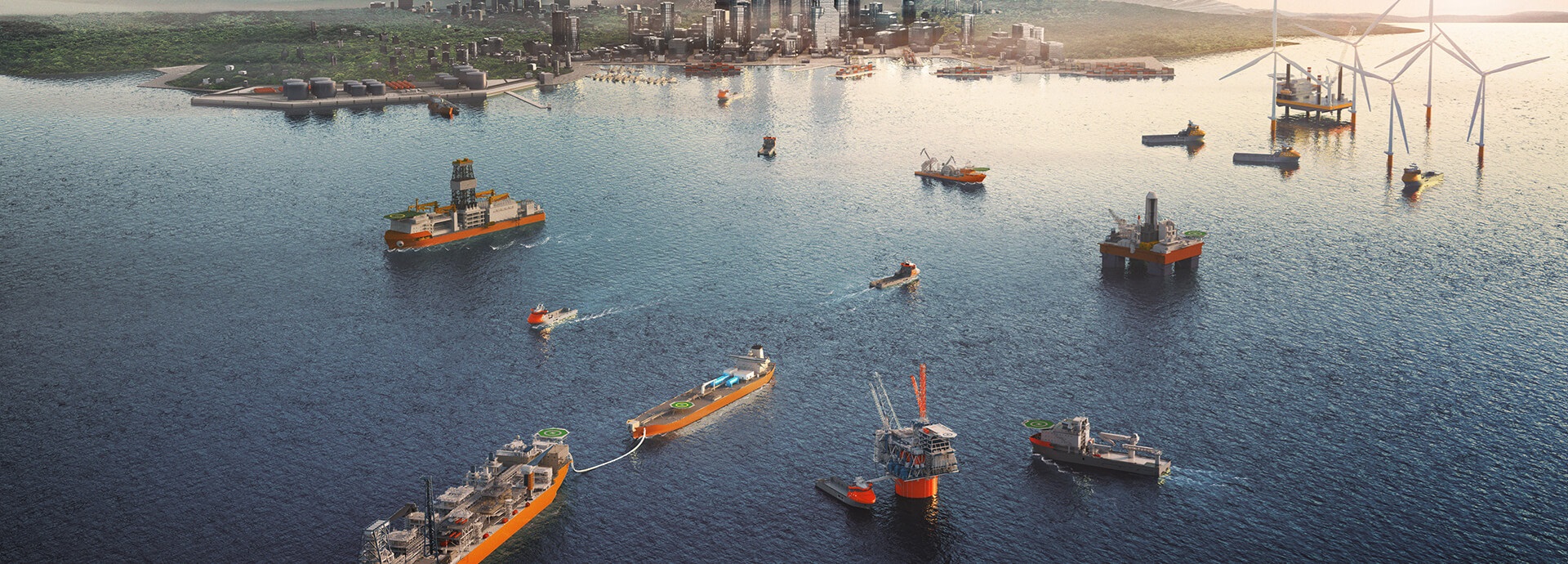
How can offshore vessel operators turn their three biggest challenges into opportunities? Whether you’re trying to comply with ever-stricter environmental regulations, dealing with the risks of operating in deeper, more remote waters or feeling the pressure to increase efficiency, this article shares some useful advice.
Three of the main challenges for owners and operators of offshore vessels are:
Let’s look at how to address each of these challenges and make vessels more attractive, profitable and future-proof.
For vessels servicing platforms and rigs in the oil and gas sector or supporting wind farm installation and maintenance, cast-iron safety and excellent manoeuvrability are non-negotiable.
There are three smart ways owners and operators can maximise safety and manoeuvrability:
Let’s look at the challenge faced and the three solutions in more detail.
The challenge: Wind turbines are getting bigger and are being built in deeper waters, meaning the vessels used to install and service them face more extreme environmental forces when doing their work. This is driving demand for larger vessels with more complex thruster systems to keep them steady and in position.
Offshore vessels require excellent dynamic positioning (DP), so thruster performance is critical to keep the vessel and its crew safe. High redundancy is essential for failure cases because of the extreme safety implications and challenging sea conditions. For example, if your vessel were to drift from its position due to a thruster failure, there is a high risk it could collide with the turbine tower. This is why operators favour drift-off scenarios over drift-on scenarios.
The traditional way to improve DP capability is to add more powerful thrusters or increase propeller diameter, but this comes with a serious downside – more powerful thrusters add weight to your vessel and make it more complex to control. Instead, you should focus on optimising your thruster configuration, which will also increase efficiency and save fuel. Here are the most important things to do:
One example of how thruster configuration has been optimised to maximise safety and manoeuvrability can be seen on the Leonardo Da Vinci, one of the most advanced cable layers in the world.
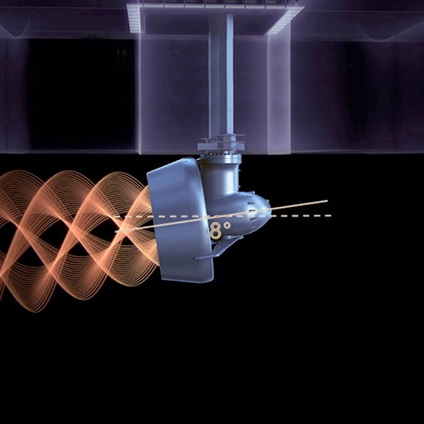
The Prysmian Group worked with Wärtsilä to design a thruster arrangement that minimises thruster-hull interactions. The Leonardo Da Vinci’s retractable thrusters, with an 8-degree tilt, allow the vessel to safely carry out deep power cable installations of up to 3,000 metres.
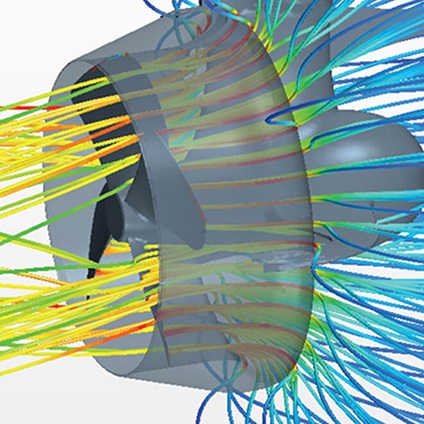
The premium-quality stainless steel nozzle components are extremely durable, requiring minimal maintenance during their lifetime. Wärtsilä partnered with FS Dynamics, a leading expert in computational fluid dynamics (CFD), and worked closely with the vessel designer to understand and verify the interaction effects on the ship. This close collaboration was vital in developing the optimal thruster setup for the Leonardo Da Vinci.
Hand-picked related content: Discover the five features that matter when station keeping in offshore operations
When you monitor system performance and identify potential failures before they happen, you reduce the risk of failure. Taking advantage of smart maintenance and service agreements will help keep your vessel running as safely as possible.
Predictive maintenance allows you to take a proactive approach. The advice and recommendations from your service partner are based on forward-looking predictions rather than historical data. This reduces risk, increases safety and extends the lifetime of your critical assets.
Operators of vessels used in the offshore oil and gas industry typically do not pay their own fuel costs or emission taxes; instead, the charterers pay. The exception is larger wind farm contracts, which sometimes require vessel owners to pay the fuel costs –making fuel efficiency essential to profitability.
Whatever your operations, improving the efficiency of your vessel and lowering its emissions can give you a competitive edge in tenders. Here are four solid ways to do this:
Here is the challenge we’re tackling and four solutions that can help.
The challenge: It’s a simple equation: when your vessel is more efficient it consumes less fuel. The less fuel it consumes, the less carbon it emits and the lower the fuel costs and emission taxes. Efficient vessels with minimal downtime are the most attractive to charterers, so maximising efficiency can give you an edge over the competition.
Hybrid solutions combine a conventional engine with an energy storage system or battery. The battery balances any load fluctuations and can be used for peak shaving and spinning reserve. This allows the engine to run at the optimal point on the specific fuel oil consumption (SFOC) curve where it operates most efficiently.
Investing in a hybrid solution reduces your engine running hours, which reduces the need for maintenance and lowers fuel consumption and emissions. This also reduces operational costs. The energy in the battery can either come from shoreside charging or from excess power available onboard when the engine is running at optimal load.
Because engines are used optimally you can sometimes reduce the number of engines needed; studies show that this can reduce fuel bills by 12–15%.
Reducing the number of engines doesn’t mean you compromise safety – the battery is used as an online ‘spinning reserve’ for the redundancy role instead of excess engines and is ready to kick in when needed. This is especially important for dynamic positioning for offshore service vessels. The battery also has the added benefits of a faster ramp up time and better manoeuvrability within the constraints of the systems architecture and engine configuration.
The top four benefits of investing in a hybrid solution:
Explore offshore hybrid solutions: Discover how Wärtsilä hybrid solutions combine batteries, energy management and propulsion technologies to reduce fuel consumption, emissions and operating costs in offshore operations.
Hybrid solutions are already benefiting US-based operator Harvey Gulf International Marine. In a first for the Americas, the company converted five platform supply vessels (PSVs) to hybrid operation. The hybrid upgrade combined batteries with engines that can run on either LNG or biogas, making the vessels more cost effective and supporting the company’s decarbonisation efforts. The vessels are now significantly more fuel efficient. The top three benefits of Harvey Gulf’s hybrid solution are:
Many owners are now prioritising efficiency as a way to get ahead in the market. AI-enabled predictive maintenance services can ensure your asset has a high utilisation rate by predicting maintenance needs and identifying potential failures before they happen. This reduces the need for unscheduled maintenance and helps to maximise asset availability.
Predictive maintenance can reduce fuel consumption by as much as 5%. It can also provide a clearer picture of when upgrades should be carried out based on your operational profile – helping you to make any possible efficiency improvements as soon as they’re identified and available.
Looking to improve availability and reduce unplanned downtime? Explore Wärtsilä Lifecycle agreements and predictive maintenance services designed to support safer and more efficient offshore operations.
Hand-picked related content: What’s the number one thing you could do for smarter ship maintenance? Find out here.
Remote monitoring, remote operations and automation provide early warning of system errors and can save costs by allowing you to safely extend service intervals. You can also use the insights from these tools to improve a vessel’s operational effectiveness.
If you operate a fleet of vessels, you can monitor multiple vessels efficiently from a single remote operations centre. This type of setup makes life easier for vessel crews and helps them manage vessels more effectively.
It is critical that your vessel design is based on the operational conditions that the vessel will face in the real world. Trial conditions at trial draft and contractual trial speeds will rarely, if ever, reflect real-world conditions.
Focus on where the energy reserves are used and the impact of weather, wind and waves on energy use. This will help the designer to dimension the vessel properly and may even reveal alternative choices that offer efficiency gains. Wärtsilä’s Opti Design methodology can help vessel designers and owners and designers uncover such gains.
Decarbonisation is no longer optional for offshore operators – it’s essential for compliance and necessary for competitiveness. And that’s not all. Today, charterers and investors often set emissions requirements too. There are three effective ways to decarbonise your operations:
Here is the challenge we’re facing and how these three solutions can help.
The challenge: Regulations for vessel emissions are evolving rapidly. The International Maritime Organization (IMO) has set an ambitious target to reach net-zero greenhouse gas emissions from international shipping by or around 2050. At MEPC 81 in 2024, the IMO also adopted new lifecycle assessment guidelines which provide a methodology for assessing vessel emissions on a well-to-wake basis.
Building on this, MEPC 83 in 2025 advanced the regulatory framework further by agreeing to measures aimed at accelerating maritime decarbonisation. These measures include a new Global Fuel Standard (GFS) and reduction factors for Greenhouse Gas Fuel Intensity (GFI) that tighten the requirements for compliance. IMO regulations apply to all offshore vessels not involved in the cabotage trade.
Norway already imposes a carbon tax on offshore vessels operating in its waters – and has done since 1991.
From 2026, all ships over 5,000 GT that call at EU ports – including offshore vessels – have been included in the EU’s emissions trading system (EU ETS). These vessels are also included in the FuelEU Maritime system, which limits the greenhouse gas intensity of energy used on board. A decision is expected by 2027 on whether offshore vessels from 400 to 5,000 GT will be included in the EU ETS.
In addition, offshore vessels over 5,000 GT and offshore general cargo vessels from 400 to 5,000 GT are also subject to the EU Monitoring, Reporting and Verification (MRV) regulation, which provides requirements for the monitoring, reporting and verification of CO2 emissions from ships using European ports.
If your vessel uses liquid natural gas (LNG) as fuel, minimising methane slip – the small amount of methane that escapes into the atmosphere when LNG is burnt as fuel – is a key priority. If you do not address methane slip you run the risk of cancelling out the environmental benefits of using LNG as fuel.
“Methane slip: how to cut regulatory costs and protect asset value” – Download this white paper to learn how methane slip translates into compliance costs under EU ETS and FuelEU Maritime, and what that means for long-term vessel value.
The path to decarbonisation will eventually require the use of low and zero-carbon fuels like methanol, ammonia and sustainable biofuels like ethanol. If your vessel is well-prepared for this transition your business will be more competitive and better able to meet developing regulations and investor expectations.
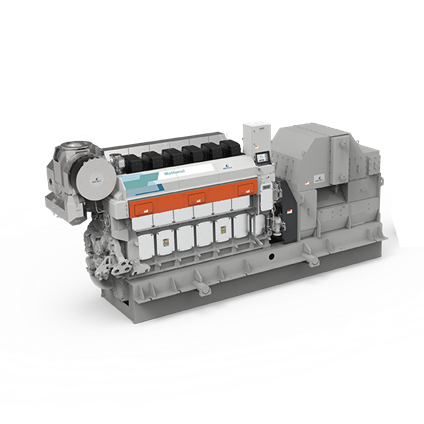
As there is still no one alternative fuel that is a clear winner for offshore, flexible engine technology is key. Flexible engines give you a wider range of fuel choices, which is particularly helpful for global operations. These engines, such as the Wärtsilä 25 and its Ammonia variant, also allow you to make a gradual transition to the alternative fuel that best suits your operational profile and geographic area of operation. You can use fossil-based fuel when necessary – then change to a more sustainable alternative fuel when the situation changes.
Norwegian shipowner Eidsvik took a major step forward on its decarbonisation journey by announcing the world’s first ammonia-fuelled platform supply vessel conversion. The vessel will use the dual-fuel Wärtsilä 25 Ammonia engine and a fuel gas supply system and exhaust after-treatment from Wärtsilä. Eidsvik has also chosen to protect the vessel with a service and maintenance agreement from Wärtsilä.
When offshore construction company Van Oord wanted to accelerate their decarbonisation journey, they decided to build an offshore wind installation vessel that can run on green methanol, a carbon-neutral fuel. Van Oord chose the fuel-flexible Wärtsilä 32 methanol engine for their new vessel, making it capable of operating on methanol or diesel.
Hand-picked related content: If you’re looking to decarbonise your offshore operations, this is essential reading: the three key actions needed to achieve sustainable shipping by 2050.
Investing in hybrid solutions is an important step towards achieving your decarbonisation goals, and these solutions can be combined with a variety of energy-saving technologies for even greater gains.
In 2020 the IMO’s Fourth Greenhouse Gas Study identified 44 currently available abatement technologies that can help vessels reduce their emissions. Since then, many more have been developed. Available options range from shaft generators to air lubrication systems and rotor sails. Owners and operators can invest in either a single solution or a combination of technologies to maximise the benefits for their vessels.
Finding the best way to decarbonise your offshore fleet can seem like an impossible task, but the benefits are huge. As well as environmental and compliance benefits, decarbonisation saves fuel and makes your vessel more attractive to charterers. If you’re wondering which decarbonisation solutions are best for your vessel and operational requirements, taking three simple steps with an expert partner could find you the decarbonisation strategy you need.
Experts can provide you with data-driven advice on the right solutions for your vessels and business case, suggesting a range of feasible options to support your strategy. From ways to save fuel to energy-saving technologies and carbon capture, an expert partner will give you a complete overview of the technologies available, tell you how to apply and integrate them – and back up their advice with data showing the difference the changes can make to your operations.
CBO, one of Brazil’s leading operators of offshore vessels, was looking to accelerate the decarbonisation of its fleet and minimise its environmental impact. Achieving this overarching goal would also reduce fuel consumption and associated costs. The company signed an agreement with Wärtsilä for decarbonisation modelling services, which combine a vast bank of vessel data with machine learning algorithms, human expertise and extensive vessel modelling experience.
Wärtsilä provided CBO with a detailed analysis of the potential benefits of various short and long-term solutions – including digitalisation, energy efficiency, energy-saving devices, hybridisation and future fuels, with a particular focus on the viability of ethanol fuel.
“CBO is strongly committed to establishing a leadership position in minimising the environmental impacts caused by shipping. Decarbonising our operations is, therefore, a priority, as is safety, which is why we are taking advantage of Wärtsilä's expertise and competence to define the fastest and most cost-effective solutions to achieve these goals.
Smart integration of new solutions means that the technology and equipment on your vessels work seamlessly together. This ensures optimal efficiency, safety and sustainability for what could be a complex setup. Most importantly, an integrated system will provide you with significantly more value than the sum of its individual parts – and having one expert supplier makes things even simpler.
All offshore vessel owners and operators are facing the same challenges of maximising safety and manoeuvrability, improving efficiency and decarbonising their operations. There are many proven solutions available, and with the right support and advice you can find the optimal combination that will maximise the benefits for your offshore operations.
Would you rather read this in a white paper?
Download the contents as a white paper: “Offshore gains – How to tackle three challenges and sharpen your edge”
Discover how other offshore operators made more from offshore in these customer reference cases.
Whether your priority is improving manoeuvrability, increasing efficiency or accelerating decarbonisation, Wärtsilä offers integrated offshore solutions covering propulsion, hybrid systems, alternative fuels and lifecycle services.
Once every six weeks, you will get the top picks – the latest and the greatest pieces – from this Insights channel by email.