
With its 'Set for 30' decarbonisation targets, Wärtsilä has committed to becoming carbon neutral in its own operations and providing a product portfolio ready for zero-carbon fuels by 2030. Recently, Wärtsilä reinforced its 'Set for 30' decarbonisation targets by committing to a new target of reducing 25% of direct suppliers' greenhouse gas emissions by 2030.
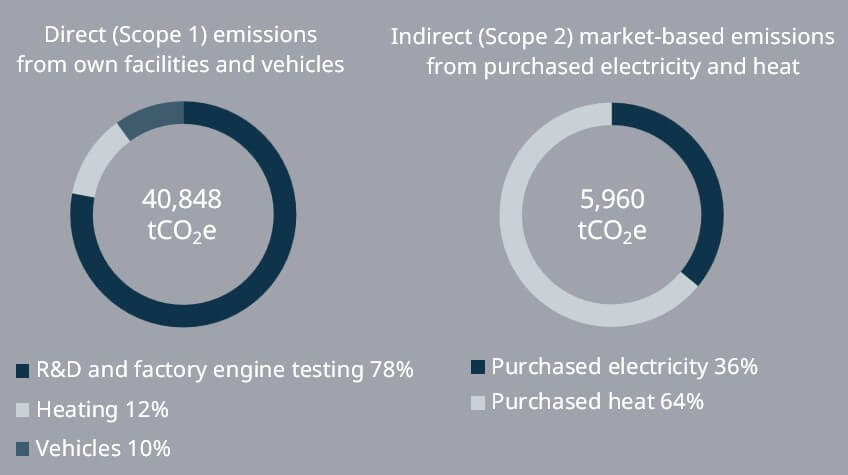
Our goal is to become carbon-neutral in our own operations by 2030. The carbon neutrality target covers direct greenhouse gas emissions from the company’s own operations, including the Research & Development and factory engine testing areas (Scope 1), as well as purchased energy (Scope 2).
As part of our decarbonisation efforts, we make action plans annually and monitor their execution throughout the year. In 2025, our GHG emissions decreased by 53% (53,192 tCO2e) compared to the baseline (3-year average from 2019–2021), which is aligned with our carbon neutrality pathway.
Our efforts in 2025 focused on low- and medium-cost measures, such as electrification and energy efficiency across our operations, reducing GHG emissions from engine testing, and increasing the share of self-generated and purchased renewable electricity.
In 2025, 79% (68,400 MWh) of Wärtsilä’s total electricity consumption in 2025 came from renewable sources. Solar energy forms a complementary part of Wärtsilä’s renewable electricity sourcing. For many Wärtsilä locations, solar panels are an attractive alternative because of their self-sufficient nature and payback time. In 2025, over 2,800 MWh of power was produced from solar panels installed at our sites.
Our target is to provide a product portfolio ready for zero-carbon fuels by 2030. Carbon-neutral fuels can already be used today, and we continue to develop our product portfolio so that zero-carbon fuels, such as ammonia and hydrogen, can be widely used by 2030.
Decarbonisation is a priority in the company’s product and product portfolio development, including abatement technologies. Wärtsilä is developing a broad range of technologies and solutions to support its customers in their decarbonisation transition.
The development of hydrogen, ammonia, and methanol technologies progressed significantly in 2025, with hydrogen moving to prototype testing and the first ammonia delivery passing factory acceptance testing. Methanol research continued alongside intensive customer support for the industrialised W32M technology.
In 2024, Wärtsilä included a new target under its Set for 30 programme, namely that our suppliers' GHG emissions should be reduced by 25% by 2030 compared to the 2024 baseline. The target covers our Tier 1 direct suppliers and their Scope 1 and 2 GHG emissions related to deliveries to Wärtsilä. It is a relative target, for which the baseline is defined by Wärtsilä-allocated GHG emissions and spend.
In 2025, we established a structured framework for reporting the suppliers’ emissions, including data collection processes, governance measures, and baseline definition. We enhanced supplier engagement by clear communication, onboarding, and integrating progress reviews into our internal systems. We also deployed digital tools and reporting structures to support monitoring and transparency.