
A shaft generator system uses a vessel's main engine to generate electrical power while sailing, reducing the need to operate auxiliary generators. This can improve energy efficiency, lower fuel consumption and reduce greenhouse-gas emissions.
Wärtsilä shaft generator systems can be installed in newbuild vessels and, in many cases, retrofitted to existing vessels as part of an energy-efficiency improvement programme. Solutions are available for fixed-pitch and controllable-pitch propeller applications, as well as hybrid and power take-in (PTI) configurations.
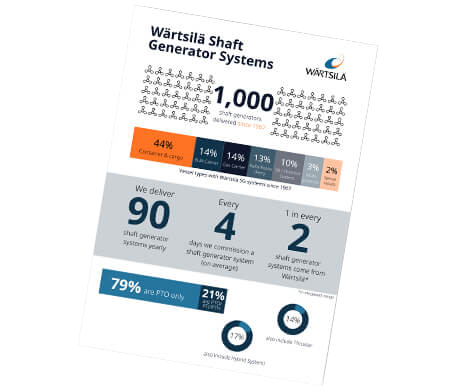
Wärtsilä has successfully delivered more than 1,000 shaft generator systems worldwide. Whether you are designing a new vessel or evaluating retrofit options for an existing fleet, Wärtsilä can help identify the most suitable configuration for your operational profile, power demand and efficiency objectives.
A Wärtsilä shaft generator system converts propulsion power into electrical power for onboard use, helping ships improve energy efficiency during normal operation.

Shaft generators on board ships are driven by the main engine to supply power to the mains. The mains have to be supplied with constant voltage and frequency by the shaft generator whilst the speed of the main engine changes, i.e. when the vessel travels at different speeds or if the propeller speed strongly varies in heavy seas.
On ships with fixed pitch propellers, the speed is set via the propeller speed. If using controllable pitch propellers, the shaft speed and the propeller pitch are adjusted simultaneously in order to achieve optimum propeller efficiency in this so-called combinator mode. Even with this type of propeller, it is thus economical to use shaft generator systems with frequency converter for variable speed in order to permit combinator mode from pier to pier.
Shaft generator systems generate electrical power very efficiently during sailing. Because shaft generators use the main propulsion system to produce onboard electricity, they help reduce fuel consumption, lower emissions and decrease auxiliary engine running hours.
Wärtsilä has delivered shaft generator systems for a wide range of vessel types and operating profiles. Today, these systems are used in both newbuild and retrofit projects as part of efforts to improve operational efficiency and support decarbonisation objectives.
Looking for more ways to improve vessel efficiency? Explore Wärtsilä's approach to energy-efficiency upgrades and optimisation.
Yes. In many cases, a shaft generator system can be added to an existing vessel as part of an energy-efficiency upgrade programme.
Retrofitting a shaft generator can help reduce auxiliary engine running hours and improve overall fuel efficiency by generating electrical power from the main propulsion system while sailing. The suitability and business case depend on the individual vessel, its operating profile, and technical characteristics.
If you operate an existing vessel and are evaluating opportunities to improve efficiency, reduce fuel consumption, or support decarbonisation goals, a shaft generator retrofit may be worth considering.
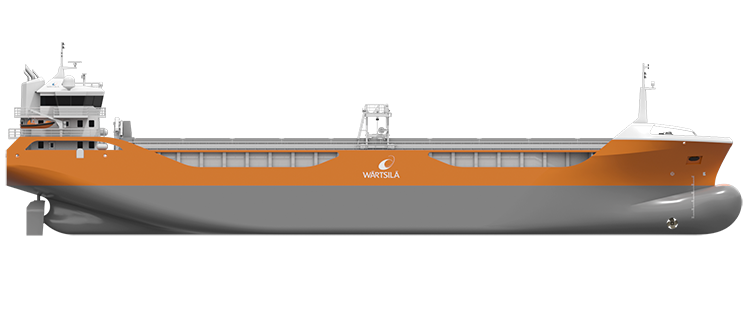
A retrofit may be particularly attractive if:
Every vessel is different. When evaluating retrofit suitability, Wärtsilä assesses factors such as:
A detailed feasibility assessment will help determine the technical and commercial potential for each vessel.
Operating multiple similar vessels? Fleet owners may be able to achieve additional benefits by evaluating retrofit opportunities across several vessels or sister ships as part of a broader efficiency programme.
Modern shaft generator retrofits are designed to minimise installation complexity and reduce vessel off-hire time. Modern shaft generator retrofits are designed to minimise installation complexity and reduce vessel off-hire time. A split-half permanent-magnet solution can allow the existing shaft to be retained and integrated into the retrofit, supporting a more installation-efficient approach.
When evaluating a retrofit opportunity, Wärtsilä works with vessel owners to identify the most suitable technical solution based on the vessel's existing arrangement, power demand and operational requirements.
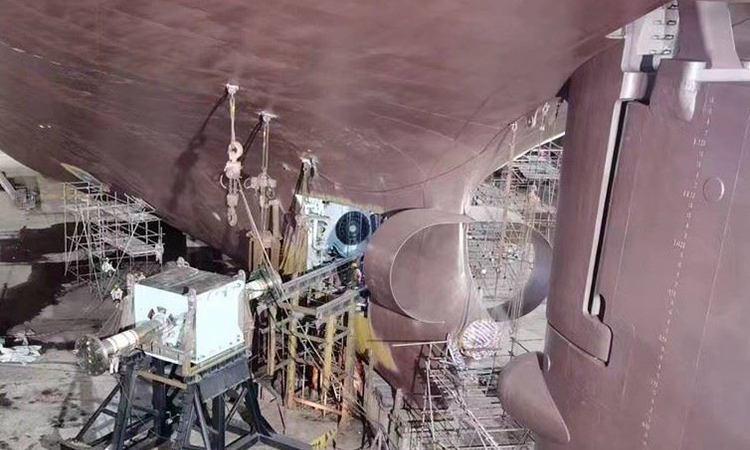
The Berge Bulk project demonstrated the feasibility of retrofitting shaft generator technology to an operating vessel and was the maritime industry's first inline shaft generator retrofit. Today, retrofit solutions have continued to evolve, incorporating installation approaches designed to reduce complexity and minimise vessel downtime where possible.
Read how Wärtsilä completed the industry's first inline shaft generator retrofit with Berge Bulk.
Discuss the retrofit potential of your vessel
If you are evaluating energy-efficiency improvements for an existing vessel, Wärtsilä can help assess whether a shaft generator retrofit could be technically and commercially viable for your operation.
Contact Wärtsilä to discuss your vessel and retrofit objectives.
No obligation: having a discussion doesn’t commit you to a purchase or any further commercial discussions.
Operational performance
All requirements of a ship‘s mains are met unrestrictedly while the shaft generator is operating:
System design
Wärtsilä’s shaft generator systems are designed with PWM frequency converters using modern IGBT technology. An additional synchronous compensator is no longer needed to generate the reactive power or the short circuit current, and is not required for the voltage control or for the filter circuits in order to lower the harmonics to admissible levels. This configuration has the following features and benefits:
Monitoring and testing
The monitoring, test and simulation display integrated in the shaft generator panel permits monitoring of the system during normal operations. However, even with the main engine out of operation, the system can still be tested and virtually all system functions can be simulated. For monitoring, test and simulation, a colour display with a touch screen provides different mimic screens, such as OVERVIEW, STATUS, VALUES, ALARM, TEST and SETUP.
Reliability and availability
The shaft generator systems are equipped with a central, microprocessor-based computer for fully digitalized closed-loop and open-loop control and for test and simulation. Compared to earlier versions, numerous PC boards with relays for logic operations and elements for analogue and digital functions, are no longer required and have been eliminated. This drastic reduction in the number of components results in a substantial improvement in reliability and availability.
Power quality
The harmonic content at the output of the shaft generator system has to be effectively reduced to admissible levels according to the classification. Wärtsilä’s shaft generator systems are designed with a PWM frequency converter with a high IGBT pulse frequency, resulting in a higher than required mains quality without any measures, such as a filter circuit or duplex reactor. The THD in the mains voltage is below 5% in all operational states.

“Shaft generator systems are a valuable technical solution for ship owners who are looking for economical and cleaner electrical power generation during their sea voyage.

Shaft generator systems will improve a vessel’s energy efficiency – and reduce emissions – because they use the main engine instead of auxiliary engines to generate electricity for use onboard.
You will find 50 more ways to reduce emissions in a fascinating eBook “51 great ways the maritime industry could cut its greenhouse gas emissions”. Learn more:
PTO

Shaft generator systems with frequency converters supply a three-phase current of constant voltage and frequency to the mains at variable main engine speeds. The useful speed range of the shaft generator can be defined from the ship’s operational requirements. For example, it is possible to select a shaft generator speed range of 60% to 100% of the main engine speed with a constant system output.
All shaft generator systems have one thing in common: The active power required for the mains is generated by the main engine. However, the shaft generator can be arranged and driven by the main engine in various configurations.
PTO/PTI/PTH

For additional shaft motor operation the diode rectifier is replaced by a PWM rectifier similar to the PWM inverter and the system control is adapted accordingly. With this configuration motor operation is provided as follows:
PTO/PTI/PTH + Hybrid

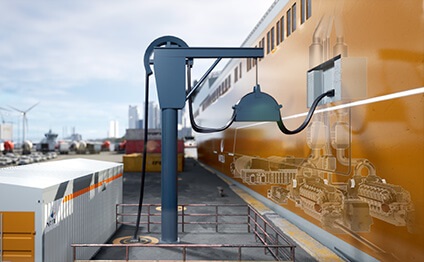
For shore connection with 50 Hz or 60 Hz the frequency converter of the shaft generator system can be used to adapt the shore frequency to the ship’s mains frequency. For that purpose the connection between shaft generator and converter is switched off and the converter is supplied (via cable reel, circuit breaker and transformer) from the shore. With this configuration the ship is full flexible for shore connection worldwide.
PTO/PTI/PTH + Thruster

One of the latest features is the integration of the shaft generator converter with thruster. In conjunction with our partners, our shaft generator system further enhances overall operational efficiency and cost savings for our customers.
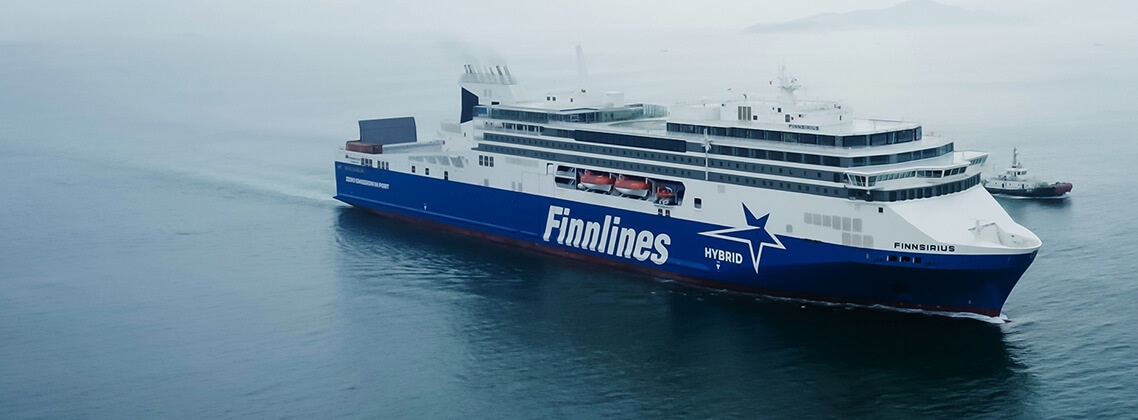
“Shaft Generators lower fuel costs, and reduce both maintenance and lubricant costs – for more profit and nature friendly benefits.
Shaft generator systems are one of several ways ship owners and operators can improve vessel energy efficiency, reduce fuel consumption and lower emissions. For suitable vessels, they can provide onboard electrical power while reducing reliance on auxiliary generators during sailing.
If you are assessing efficiency improvements for a newbuild vessel or an existing fleet, Wärtsilä can help evaluate whether a shaft generator system could contribute to your operational and decarbonisation goals and identify the most suitable solution for your vessel.