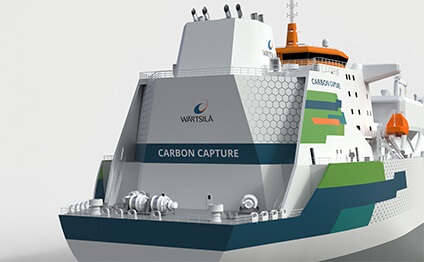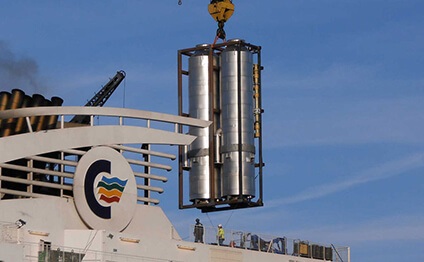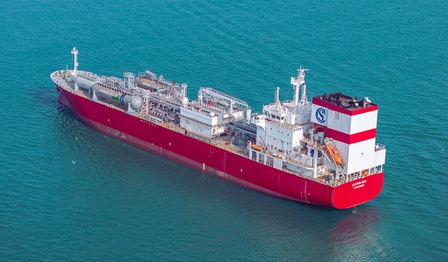
As regulatory pressure increases and emissions get more expensive, shipowners are looking for practical ways to cut CO2 today. Onboard carbon capture is one technology showing that significant reductions are achievable – with a pilot system demonstrating reliable capture levels of around 70%.
In the maritime industry, discussions about how to decarbonise and reduce emissions have often focused on alternative low or zero-carbon fuels and long-term fleet renewal. These pathways are essential, but change is needed at a faster pace than these methods allow. Shipowners and operators are asking what they can do to start tackling emissions today.
This is where onboard carbon capture (OCC) can help.
Carbon capture for ships is a method of capturing CO2 from fossil fuel after it is combusted in an engine or boiler, before it can be released into the atmosphere. The technology can also be used with fuels such as green methanol to make them net carbon negative. Onboard carbon capture is an important technology because it can be retrofitted to most vessels to immediately reduce carbon emissions. If all ships currently running on fossil fuels installed a carbon capture system with a 70% capture rate, we could meet the 2040 decarbonisation targets set by the International Maritime Organization (IMO) today.
In Europe, the EU Emissions Trading System (EU ETS) expanded to 100% coverage from 2026, turning every tonne of CO2 emissions into a direct and measurable cost. In addition, FuelEU Maritime has introduced binding well-to-wake greenhouse gas intensity limits that will tighten as we get closer to 2030. Globally, the IMO’s GHG Strategy sets clear reduction expectations for 2030 and beyond. Even when policy discussions are evolving or being postponed, there is a clear general direction: emissions need to decline significantly. While EU ETS is still the only scheme that recognises carbon capture as emission reduction technology, it is widely expected that FuelEU Maritime and the IMO will do so in the not too distant future.
At the same time, commercial expectations are increasing. Charterers, cargo owners and financiers are incorporating emissions performance into procurement, reporting and lending frameworks. For shipowners, lower emissions is a competitive advantage.
These pressures make onboard carbon capture an attractive near-term option for achieving measurable CO2 reductions. For those ready to invest, it is clear that in many cases carbon capture is the technology that will give you the most bang for your buck in terms of largest CO2 reduction per dollar spent.
Carbon capture for ships is a proven emissions-reducing technology that is ready to be installed today – and emissions cuts made now will have a greater impact on greenhouse gas targets than cuts made in the future.
Carbon capture offers shipowners a clear path to reducing emissions now, while longer-term fuel and infrastructure pathways continue to mature. Whichever alternative fuel your vessel uses in future, there will be emissions to clean up – carbon capture can help reduce or eliminate them. For example, if you sail on blended fuels you could achieve net zero with carbon capture. If you sail on 100% green methanol, carbon capture could help you achieve net negative emissions.
Even with efficiency improvements, many vessels face a widening compliance gap – the difference between their emissions performance and the level mandated by regulatory targets. The level of CO2 reduction needed will vary by shipowner, trade and vessel type. Some owners are targeting incremental improvements of 10–20%. Others are looking at much higher reductions of 90% or more, driven by regulatory exposure, corporate climate commitments or charterer expectations.
If all vessels currently sailing integrated carbon capture technology with a 70% capture rate, we could become compliant with the IMO’s 2040 target today. Onboard carbon capture is a flexible bridging solution – it doesn’t replace other decarbonisation methods such as efficiency improvements or alternative fuels. Instead, it complements them by reducing emissions from fossil-based fuels today and sustainable fuels in future.
For most vessels, practical real‑world carbon capture levels sit around 70%, based on pilot performance. Higher capture levels of up to 95% are also technically possible. The greater the amount of carbon captured, the greater the system cost, system size and energy demand.
In other words, you can capture anywhere between 10 and 95% of carbon emissions depending on what your business targets are and what your vessel needs to achieve.
Importantly, carbon capture works with any carbon-based fuel. Whether you’re operating on fossil-based fuels, biofuel blends or synthetic fuels, CO2 emissions can be captured from your vessel’s exhaust gases. This makes onboard carbon capture compatible with your evolving fuel strategies, rather than locking you into a single pathway.
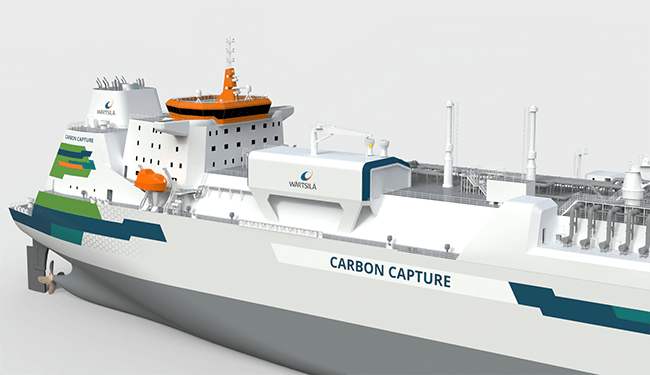
The pros of onboard carbon capture are that it is:
The cons of onboard carbon capture are that:
The carbon capture rate is influenced by several factors, including the size of the system and the waste heat availability. In general, higher capture rates require more energy and space. If you have plenty of waste heat to reuse, it will increase performance and lower the cost of operating a carbon capture system.
Classification societies are beginning to formalise requirements for carbon capture. The American Bureau of Shipping was the first with its “Requirements for Onboard Carbon Capture and Storage” in July 2023. DNV has also created a dedicated onboard carbon capture class notation, outlining requirements to guide safe design, integration and operation of carbon capture systems.
The CO2 value chain is also maturing. The Global Centre for Maritime Decarbonisation (GCMD) has completed the world’s first end-to-end demonstration of shipboard CO2 capture – from onboard capture to offloading, transportation and use – with CO2 purity consistently about 99.95%.
All this shows that onboard carbon capture for ships is becoming operationally and commercially viable.
Onboard carbon capture makes financial sense when emissions carry a direct cost or where reducing emissions increases a vessel’s commercial value or gives it a competitive edge.
Carbon pricing mechanisms such as EU ETS will eventually make it more expensive for ships to emit CO2 than to capture it. Shipowners also need to weigh up the business case for carbon capture. This means considering installation costs, operational costs and the cost of storing and offloading captured CO2.
As carbon prices rise, capturing emissions can become financially preferable to paying for allowances.
Beyond regulatory pricing, in some maritime segments having a low-emission vessel makes your product a more attractive option for buyers. This is particularly true for cruise and ferry segments, where passengers actively look for companies that can offer low-emission options.
Leading shipowners are starting to evaluate whether onboard carbon capture is right for their fleet. Want to know how they’re getting started? Here’s a no-nonsense checklist of how to proceed:
Onboard carbon capture for ships is no longer theoretical: it is a proven technology with clear benefits. If you are evaluating whether it could work on your vessels, the next step is to understand the technical fit, capture potential and cost impacts for your specific fleet.
If you’re interested in reducing your CO2 emissions by up to 70% with a carbon capture system, feasibility studies are available today.
Written by
Once every six weeks, you will get the top picks – the latest and the greatest pieces – from this Insights channel by email.