Hybrid ships are moving fast – and not always in the ways people expect. From battery technology and energy management to charging infrastructure and system design choices, the hybrid landscape is evolving well beyond early pilot projects.
If you’re considering a hybrid set‑up for a newbuild or a retrofit, understanding where the market is heading is just as important as understanding today’s technology. These seven trends highlight what is shaping hybrid ship design and operation right now – and what you’re likely to see more of over the coming years.
What trends do we have to look forward to in the world of hybrid ships? Experts predict that the coming years will see:
Before diving into the trends, here’s a quick refresher on how hybrid ships work and why they matter. If you’re already familiar with hybrid vessels, click here to skip ahead to the first upcoming trend.
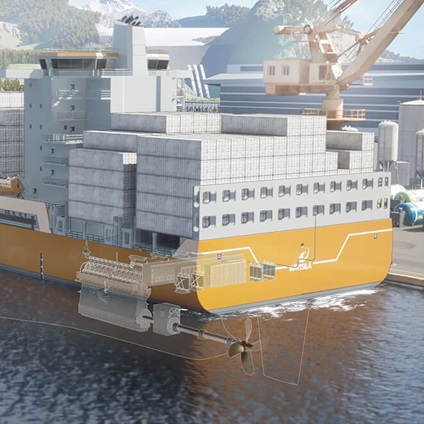
Hybrid ships are vessels that use two power sources, usually a conventional combustion engine and a rechargeable battery. A hybrid ship can be as small as a local ferry or as large as a Pure Car and Truck Carrier (PCTC).
The number of hybrid ships is growing across all maritime segments. The offshore industry used to be the biggest market for ships with hybrid systems, but today there are hybrid versions of:
Hybrid electric ships have a battery and a conventional combustion engine. A hybrid ship can instantly switch between engine and battery when required, or the engine and battery can be used simultaneously. The battery is used in one of two ways:
The key to maximising the benefits of a hybrid system is a dedicated energy management system (EMS). A dedicated EMS will optimise the interaction of the different power sources and protect the battery by directly controlling the converter that determines the battery charge and discharge rate. A standard power management system (PMS) cannot do this.
A hybrid ship will save you money compared to an equivalent diesel-powered vessel by providing fuel savings of 15–25%. You will also save money through lower maintenance costs. The gensets on a hybrid ship are subject to less wear and tear because they can be powered down when the battery takes over.
There are four main benefits of hybrid ships:
The latest trends for hybrid ships indicate what the future holds for hybrid vessels. There are seven fascinating trends that we’ll see in the coming years. What could they mean for you?
All marine batteries are lithium-ion batteries, similar to ones from the automotive and energy industries. Now we’re starting to see the introduction of new lithium-ion battery chemistries for use on ships.
In the past, nickel-manganese-cobalt (NMC) batteries were the standard for maritime applications, but now lithium-ferro-phosphate (LFP) batteries are rapidly becoming the default choice. Another emerging battery type for ships is lithium-titanium-oxide (LTO) batteries.
What does this mean for ship owners?
These new battery types offer varying advantages depending on the application area, such as:
Every manufacturer of marine batteries for ships has their own claims about their product, and the number of marine battery suppliers is growing all the time. As a leading global marine electrical integrator, Wärtsilä can give you a full market overview and recommendations for your specific vessel application. Wärtsilä experts can advise you on the best battery chemistry and the optimal solutions for your vessel.
In the past, batteries on hybrid ships were mostly used for spinning reserve, where the battery provides the entire load for the application. For example, the auxiliary genset would be turned off and the battery would provide the power for station keeping in offshore applications. Batteries were smaller and they were also used for peak shaving and ramp-up support.
Today’s marine batteries of up to 54 MWh make it possible to achieve zero-emission operations. A marine battery with this level of capacity can also provide power for the ship during harbour stays.
However, the size of the battery in a hybrid ship is not the only important factor to consider. The right battery for your ship depends on how it will be used and the operating profile of the vessel.
Lower prices are not the reason for the trend of more powerful batteries alone. The steady decline in battery prices seen prior to 2020 has slowed down. With the increasing global demand for the cells and their raw materials, the price of marine batteries for hybrid ships is not likely to fall further.
Bigger batteries offer more flexibility for zero-emission ship operation as the batteries on a hybrid ship can take on more energy-intensive tasks. Designing a hybrid propulsion system based on your operating profile can lead to new ways to operate your vessel and even greater efficiency gains.
For example, you can add a variety of different modes to a Wärtsilä HY propulsion system that will automatically run the propulsion train at optimal efficiency.
A hybrid ship propulsion system designed around a battery is much more efficient than older propulsion designs and can deliver significant savings. For example, the hybrid Misje Vita bulk carrier has achieved up to 40% fuel savings compared to similar vessels in its fleet.
Battery technology has proven its long-term reliability in the demanding world of shipping. A reliable marine battery is crucial for the smooth operation of ships, and Wärtsilä has been a pioneer in this field. There are Wärtsilä marine batteries that have been in use for 15 years, and they continue to perform well. This makes us the only integrator to achieve such a level of reliability.
Battery function is more important than battery size because the battery on a hybrid ship helps optimise the propulsion system, so its ideal size depends on the vessel’s operational profile. Different modes make it possible for the vessel operator to choose the most efficient way to run the propulsion system. For example, when shore-side charging is required, sailing considerations are not as important for battery sizing as charging time and capacity.
“Because the battery helps optimise the propulsion system, its ideal size depends on the vessel’s operational profile.
Designing the battery system based on function is becoming more common. This makes for better propulsion systems. It can also spark innovation in ways to operate a vessel more efficiently.
Adding a battery to a ship’s existing propulsion system will just add weight to the vessel. To get real benefits, the propulsion system must be redesigned based on the functionality of the vessel.
Rethinking ship design can lead to significant cost savings compared to the original designs. If a hybrid vessel does not have less installed power, you should involve an expert to re-evaluate the design.
A fuel cell works like a battery that doesn’t need recharging. A fuel cell produces electricity and heat as long as it has fuel and an oxidizing agent. Both batteries and fuel cells provide direct current (DC) electric power.
Batteries are good at variable loads, while fuel cells are best for stable base loads as they do not react well to load changes. This is why fuel cells are always accompanied by batteries.
Proton-exchange membrane fuel cells (PEMFCs) are now available for maritime applications. PEMFCs have more than 50% efficiency when hydrogen is used directly. If you need a reformer to make hydrogen from another fuel such as LNG, a PEMFC is still as efficient as a good combustion engine – but much more expensive.
The more interesting fuel cell technology currently under development is solid oxide fuel cells (SOFCs). SOFCs can directly use methanol or ammonia to produce electricity. Wärtsilä is currently delivering its first SOFC together with a major cruise operator.
Some ship owners will pilot this technology to gain experience, but for most owners it’s a case of watch and wait.
PEMFCs are an option for ship owners who are planning to use hydrogen as fuel for ships. If you decide to use hydrogen as fuel for your ships you will need more space to store the hydrogen, and the added weight of the fuel storage equipment will decrease the range of your vessel.
A DC hub is a new integration concept for powertrains that uses direct current (DC) for electricity distribution.
Hybrid ships typically have:
Until recently, electricity onboard hybrid ships has been distributed in AC where needed. However, the DC hub electrical integration concept has become popular. The DC hub uses DC for electricity distribution.
When the main power source on a hybrid ship is a battery producing DC, a DC hub can make sense because it eliminates a transformation step. However, a DC hub is not the right answer for every hybrid vessel.
More and more hybrid ships are being designed with only a DC hub, which may prove to be a mistake.
Consider a ship with a diesel generator as the main power source, producing AC. If the main consumer of that power is an electric motor or the hotel load – both of which require AC – converting the power from AC to DC and back again will produce heat and electric losses.
DC hubs can make sense for smaller hybrid vessels with small high-speed engines, but they will not be ideal for high-powered vessels with many engines or larger hybrid vessels. If you are investing in a high-powered or larger hybrid vessel you should connect the gensets to an AC grid and connect the batteries and other AC consumers to small DC hubs. These DC hubs form part of the total diesel-electric hybrid power train.
Hand-picked content:
Wondering whether a DC hub would be right for your hybrid ship? Read more in “Are DC hubs right for your ship? How to make smart decisions about electrical distribution”.
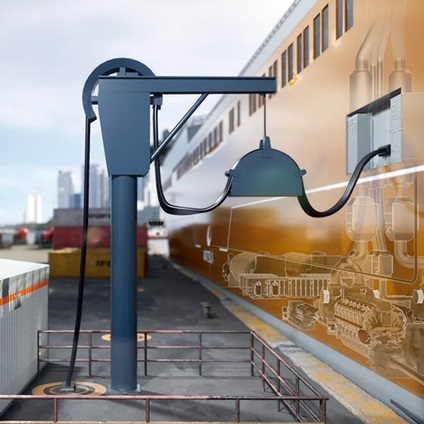
The IEC 80005 standard for high-voltage shore connection (HVSC) systems has been in place since 2011. HVSC systems allow ships to be supplied with electrical power from the shore. These systems were originally designed to eliminate the need for ships to use auxiliary gensets to generate power to cover their hotel load while in port.
Because HVSC systems can also be used to charge the batteries of hybrid ships, all big RoPax, RoRo and PCTC vessels currently being built with hybrid propulsion are equipped with IEC 80005 shore power connections. These hybrid ships can charge their batteries with shore power in any port that provides it – and by 2030, all major ports will.
The capability of IEC standard shore power is simple. For example, if a RoPax terminal provides 5.5 MW of shore power and the hotel load of your hybrid ship while in harbour is 2 MW, you can use the rest of the available power – 3.5 MW – to charge your ship’s batteries.
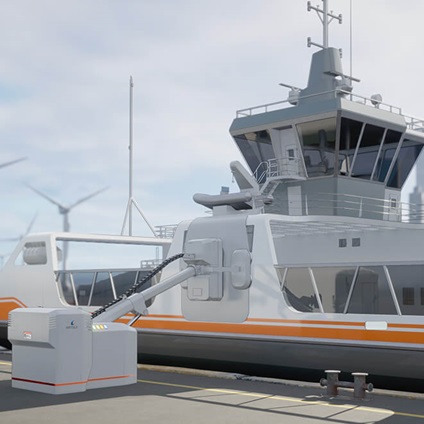
The disadvantage of HVSC systems is that connecting to them takes a few minutes. Your hybrid ship will need a faster connection solution if charging time is critical – for example, if you are operating a ferry with short port turnaround times. This is where the so-called ‘ferry chargers’ come into play.
The Megawatt Charging System (MCS), designed for trucks, has brought a step change in ferry charger standardisation. MCS features standard plugs that are easy to handle by one person. The system can also transmit up to 3 MW of power in a very short time.
For a good example of how well automotive standards can work for marine, check out how the MD Medstraum, the world’s first zero-emission fast ferry, is successfully powered with standard CCS2 chargers, the same type used for electric cars.
Standardisation means charging will become easier and faster. If your vessel is equipped to plug into IEC standard shore power the connection will take a few minutes. If you need a faster connection solution, a ferry charger can connect within 30 seconds. Ferry chargers can connect automatically or manually but are currently manufacturer specific, so you can only use them for a vessel that always runs the same route.
The power that ferry chargers can provide is increasing every year: the largest can now provide 50 MW AC medium voltage power to a ship, or over 8 MW in DC with no further conversion needed on board.
Hybrid systems are available as retrofits – for example Wärtsilä has completed around 30 hybrid retrofits in the last 13 years. Most retrofits have traditionally been on offshore ships and included the standard Wärtsilä HY Module.
Ferry owners also have choices:
Because some gensets can be removed, space and weight are usually no issue. Other changes can also be managed, especially if there is a diesel-electric propulsion train.
The available charging time and power usually define the sizing of the new hybrid system more than the sailing considerations do. Another factor in the hybrid ship conversion business case is the available support from local authorities for the charging setup.
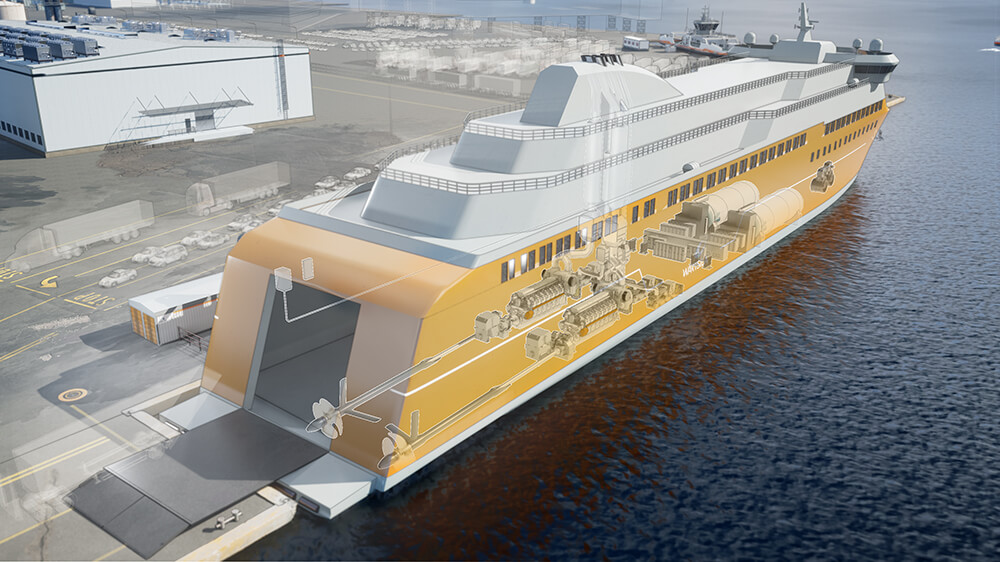
If you are interested in retrofitting your vessel to turn it into a hybrid ship, there are two main actions to take:
If you want to get the most out of your newbuild hybrid ship or hybrid retrofit, it’s best to talk to the experts. Wärtsilä are market leaders in hybrid vessels, with 150 vessels and 400 MWh battery capacity. Our experience and knowledge will help you find an optimised solution that is based on your operating profile – delivering efficiency, performance and reduced carbon emissions.
The best company to buy a hybrid ship system from is one that can deliver a design that combines engines, energy storage and an intelligent energy management system into one integrated solution. The Wärtsilä HY integrated hybrid-electric propulsion system helps ship owners reduce fuel consumption and emissions, improve operational efficiency and meet tightening regulatory requirements for newbuild and retrofit projects.
A hybrid ship saves fuel, and therefore money, in three main ways:
Hybrid ships make it easier to meet increasingly strict emissions requirements, which reduces the costs related to the EU Emissions Trading System (ETS) and FuelEU Maritime penalties. They do this by reducing the amount of fuel burnt.
As these trends accelerate, choosing the right hybrid architecture early becomes a strategic decision – not just a technical one.
Whether newbuild or retrofit, discover how you can save fuel, cut emissions and meet EU ETS and FuelEU Maritime requirements with Wärtsilä HY hybrid propulsion systems for ships.
Once every six weeks, you will get the top picks – the latest and the greatest pieces – from this Insights channel by email.