
Shipping companies are entering a more complex and capital-intensive phase as decarbonisation regulations begin to translate emissions targets into direct operating costs and long-term investment pressure. This is according to a new global survey of senior maritime executives commissioned by technology group Wärtsilä.
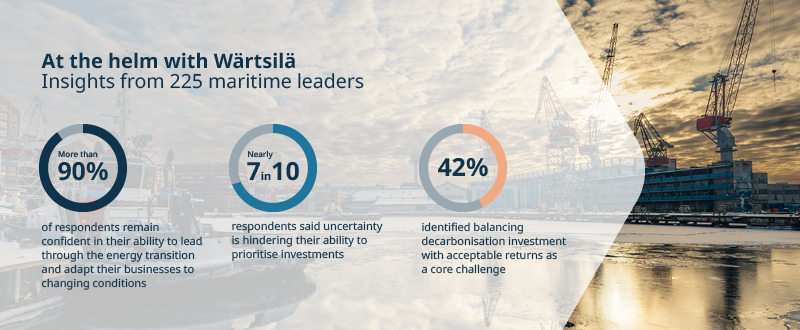
The study, based on responses from 225 maritime leaders, found that more than 90 percent of respondents remain confident in their ability to lead through the energy transition and adapt their businesses to changing conditions. At the same time, uncertainty around technology pathways, fuel availability, talent retention and regulatory developments is making strategic decision making more difficult. Nearly seven in ten respondents said uncertainty is hindering their ability to prioritise investments, while 42 percent identified balancing decarbonisation investment with acceptable returns as a core challenge. Despite these challenges, the report makes clear that delaying action is not a viable strategy. Rather than waiting for full regulatory or technological clarity, maritime leaders need to build flexibility and optionality into their investment plans - ensuring they can adapt as the transition progresses.
With measures, such as the European Union’s Emissions Trading System and FuelEU Maritime, turning emissions performance into a financial variable, the report highlights growing execution risk for vessel owners and operators. Investment timing, fuel choices, and asset utilisation are increasingly being determined under regulatory pressure, fluctuating fuel costs and evolving technology options. Missteps in these areas could affect long-term competitiveness and asset value.
The findings are outlined in Wärtsilä’s new report, At the helm in shipping – how to navigate regulation, risk and ROI, which examines how ship owners and operators are responding to increasing regulatory complexity and the pressure to balance compliance, investment and day-to-day operational demands.
The report highlights how long-term partnerships between operators and original equipment manufacturers can help reduce uncertainty by providing access to operational data, technical expertise and lifecycle insights. Such collaboration enables predictive maintenance and more data-driven asset management, helping to protect vessel performance and long-term asset value.
As environmental frameworks continue to evolve – and as emissions performance becomes more closely tied to commercial outcomes – improving vessel efficiency and operational performance will remain essential to managing both compliance risks and return on investment.
Roger Holm, President of Wärtsilä Marine and Executive Vice President at Wärtsilä Corporation, says: “Maritime leaders remain confident in their ability to adapt to the energy transition, but the decisions they face are becoming more complex. With tighter regulation and evolving fuel choices reshaping investment decisions, ship owners and operators cannot wait. They need to take proactive steps now – prioritising data, collaboration and future‑proof solutions to protect competitiveness over the long-term. Ultimately, the most resilient operators are those preparing for multiple pathways - creating flexibility today so they can respond quickly as the regulatory and fuel landscape develops.”
The survey is based on a quantitative survey of 225 maritime leaders – including CEOs, VPs, senior operations managers and ship owners – conducted in 2025. The full report is available here: At the helm in shipping – how to navigate regulation, risk and ROI.
Media contact for more information on this release:
Isabella Alder
Positioning and Strategic Communications Manager
Wärtsilä Marine
Tel: +44 (0) 7792 681 757
[email protected]
Image caption: Shipping companies face greater complexity and investment demands as decarbonisation regulations begin to turn emissions targets into direct costs, according to a new global survey by Wärtsilä © Wärtsilä Corporation
All Wärtsilä releases are available at https://www.wartsila.com/media/news-releases and at http://news.cision.com/wartsila-corporation where also the images can be downloaded. Use of the image(s) is allowed only in connection with the contents of this press release. Wärtsilä images are available at https://www.wartsila.com/media/image-bank.
Wärtsilä Marine in brief
Wärtsilä Marine is a global pioneer in power, propulsion and lifecycle solutions for the marine market. We develop industry-leading technologies, advancing maritime's transition to new fuels. We support building an end-to-end digital ecosystem where all vessels and ports are connected. Ultimately, Wärtsilä Marine is driving the shipping industry forward on its journey towards a decarbonised and sustainable future through our broad portfolio of engines, propulsion systems, hybrid technology, exhaust treatment, shaft line solutions and digital technologies, as well as integrated powertrain systems. Our offering, which is underpinned by our performance-based agreements, upgrades, lifecycle solutions, decarbonisation services, as well as an unrivalled global network of maritime expertise, delivers the efficiency, reliability, safety, and environmental performance needed to support a safe and sustainable future for our customers, our communities and our planet.
www.wartsila.com/marine
Wärtsilä in brief
Wärtsilä is a global leader in innovative technologies and lifecycle solutions for the marine and energy industries. We emphasise innovation in sustainable technology and services to help our customers continuously improve environmental and economic performance. Our dedicated and passionate team of 17,900 professionals in 199 locations in 78 countries shape the decarbonisation transformation of our industries across the globe. In 2025, Wärtsilä’s net sales totalled EUR 6.9 billion. Wärtsilä is listed on Nasdaq Helsinki.
www.wartsila.com
