Case study: How Nergård Havfiske increased the lifetime of a trawler by up to 20 years
- Challenge: Extend the lifetime of a trawler and increase the engine output
- Solution: A new power solution based on the Wärtsilä 32 main engine
- Benefit: Improved vessel efficiency with more power and lower emissions, extending the vessel lifetime by up to 20 years
With sanctions against Russia effectively stopping the used-vessel market for trawlers, Norwegian fisheries company Nergård Havfiske had a difficult decision to make. Invest in a new billion-kroner trawler, or find a smart way to extend the lifetime of Kågtind II, the company’s oldest vessel?
The challenge: rising newbuild costs and no second-hand market
Norwegian Nergård Havfiske is one of the largest pelagic fish producers in Norway, with a fleet of five freezer trawlers catching fish that is sold around the world. The company has grown slowly but steadily since starting as a family business with a single vessel in 1947. Their strategy has always been to invest regularly in their vessels to stay ahead of the competition, with the latest addition being the NOK 600 million freezer trawler Sørkapp in December 2023.
Since then, the market has changed dramatically. Norwegian ship owners have historically sold older ships to downstream markets such as Africa, Southern Europe and Russia. However, the geopolitical climate, particularly in relation to Russia, has made this much more challenging. Costs have also been increasing, with new trawler prices now reaching nearly one billion kroner. With little second-hand market for Nergård’s oldest vessel, Kågtind II, Nergård looked instead at options to extend the vessel’s lifetime rather than opting for a replacement.
The solution: A new power solution based on the Wärtsilä W6L32 engine
Depending on whether the gearbox and propeller need replacing, an engine upgrade for a trawler usually costs between NOK 50 and 70 million. This makes retrofit options very attractive compared to paying out close to a billion NOK for a new vessel. Nergård decided to retrofit Kågtind II with modern Wärtsilä systems to improve efficiency, reduce emissions and extend the vessel’s lifetime. Wärtsilä’s project team designed an elegant solution that matched a new W6L32 main engine to the vessel’s existing gearbox, saving the shipowner considerable CAPEX.
Retrofit solutions have become the logical choice for shipowners – with cost-effective efficiency improvements possible for even the oldest vessels. Consulting with an experienced partner like Wärtsilä can help shipowners make the right investments, showing just how much can be saved on fuel and emissions with different equipment options.
Most operators recoup their investment in just a few fishing seasons, and there are also various subsidy schemes available. These include Norway’s NOx Fund, which provides financial support for emissions-reducing investments. The fund is a major driver of innovation in the country, allowing Norwegian shipowners to be more forward-leaning and technology optimistic than is often possible elsewhere. Since the NOx Fund was established in 2008, it has supported around 200 engine upgrades, reducing NOx emissions in Norway and contributing to fulfilling Norway’s commitments under the Gothenburg Protocol and the EU’s emissions directive.
After evaluating the options and with support from the NOx Fund, Nergård worked with Wärtsilä Norway to develop a solution comprising:
- a new larger main engine, the Wärtsilä W6L32, mounted on rubber feet for reduced vibration and noise
- a new auxiliary engine
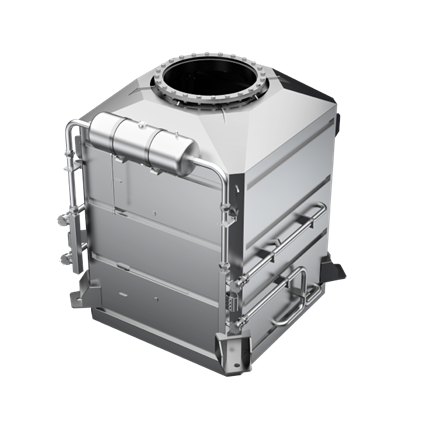
- a Wärtsilä NOx Reducer (NOR) emission after-treatment system based on selective catalytic reduction technology
The upgrade was performed at Båtbygg in Måløy, Norway.
The benefit: improved efficiency, reduced emissions and an increase in trawler lifetime of up to 20 years
After the retrofit, Nergård saw the following benefits for Kågtind II:
- 5–10% lower fuel consumption
- significantly reduced NOx emissions – helping exceed Nergård’s target to cut emissions by 83 tonnes a year
- a more comfortable working environment for crew
- an estimated increase in vessel lifetime of up to 20 years
A key advantage of the new, more powerful engine is that it has sufficient spare capacity to produce electricity using a shaft generator, removing the need to run auxiliary engines, which typically are less efficient. Alternatively, a slightly larger main engine can help to fulfil shipping quotas in fewer days. Both of these can result in fewer tonnes of CO2 emitted per tonne of fish caught, making fishing more sustainable.
“The old engine on Kågtind II was too small – the larger Wärtsilä engine has a lower RPM so it runs more smoothly, making life easier and more comfortable at sea. The crew no longer need to constantly adjust the engine and we estimate that fuel consumption has been reduced by 5–10%.
Kenneth Holmøy, General Manager, Nergård Havfiske
Find out more about Wärtsilä lifecycle upgrades