As power systems become more complex, renewable penetration increases, and market conditions become more volatile, the value of generation resources is changing. Power providers need flexible power generation technologies that can respond rapidly to uncertainty, support evolving reliability requirements, and deliver more than capacity alone.
Reciprocating internal combustion engines (RICE) deliver the combination of dispatchable generation, fast response, operational flexibility, and dependable capacity needed to support resource adequacy, renewable integration, grid flexibility, and long-term system reliability. These systems consistently outperform steam turbines (ST) and aeroderivatives (aeros).
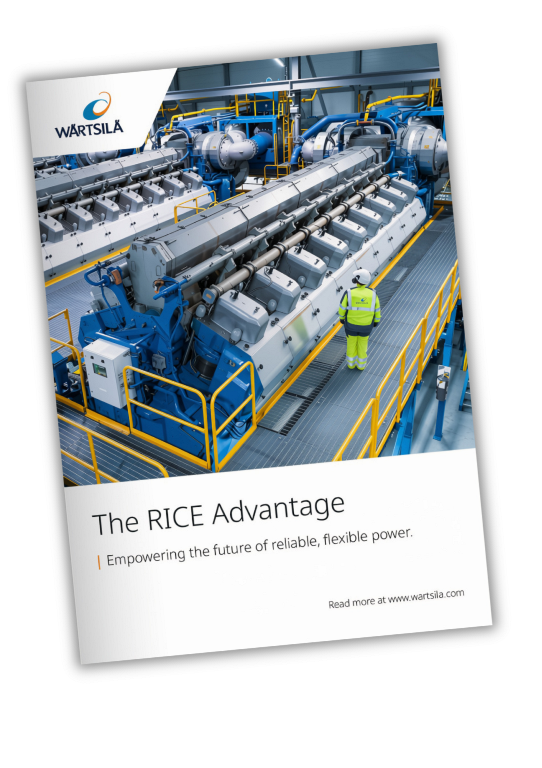
Explore the latest insights on RICE technology in Wärtsilä’s new brochure:
system savings compared to aeros.
average annual system savings.
ancillary services revenue vs. aeros.
performance based capacity accreditation.
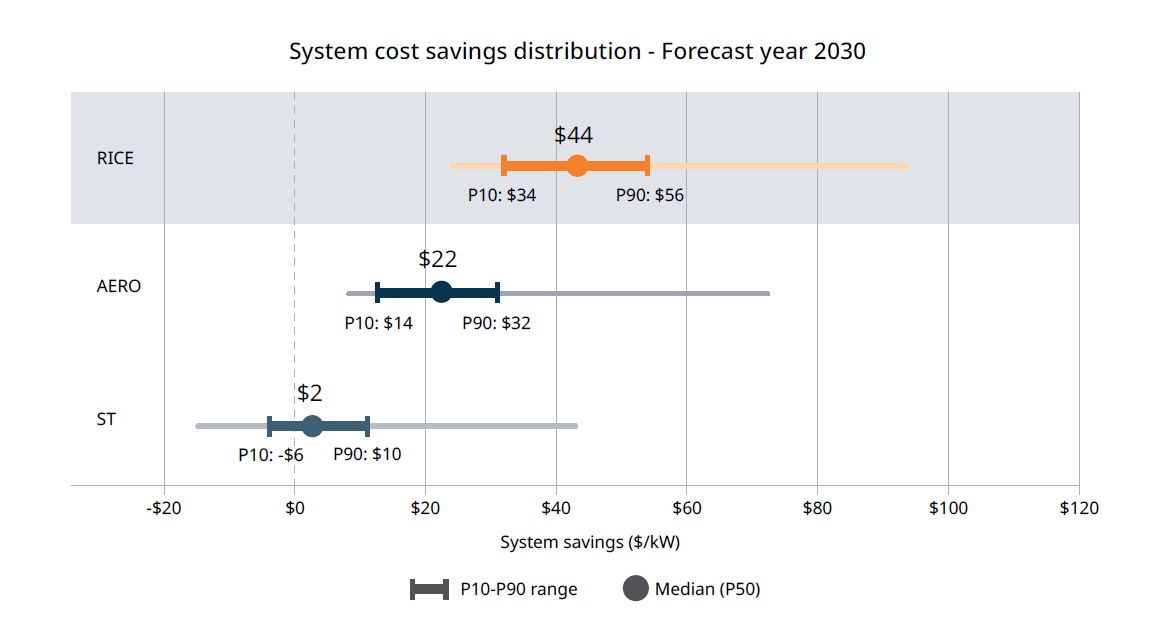
A recent PowerGEM study found that adding 500 MW of RICE to a major U.S. utility system in the southern SPP footprint delivered greater economic value, flexibility, and reliability than aeroderivatives and steam turbines.
The results are based on thousands of hourly simulations, stress-testing each technology against real-world uncertainty and holding all three to the same strict reliability standard.
The study showed that RICE delivered about twice the average annual system savings of aeros, achieved higher capacity accreditation and gas turbine efficiency, and improved responsiveness, helping reduce costs and strengthen reliability during critical hours. Overall, RICE helped utilities capture more value from every megawatt while better responding to system uncertainty.
In the 2024 forecast, even RICE’s most conservative outcome still outperformed 90% of aeros.
By comparison, steam turbines delivered just $1M in annual system savings, a fraction of what reciprocating internal combustion engines and aeroderivatives achieved.
RICE engine power plants are designed to provide the operational characteristics that modern power systems require. Their combination of efficiency, fast response, and flexible operation enables them to serve as high-value firm capacity resources while supporting energy and ancillary service markets.
With fast response to changing net load conditions, strong ramping capability during critical system hours, frequent-start operation, and the ability to support balancing power needs, RICE engine power plants give operators more ways to respond to volatility while participating in energy and ancillary service markets.
Explore how flexible engine generation can help increase system value and strengthen reliability as explored in the PowerGEM study.

Supports renewable integration

Delivers balancing power to support reliability

Responds quickly to net-load variability

Contributes to resilient system operation

Reduces exposure to market volatility
By adding flexible, dispatchable power to the system, operators can better balance variable outputs as conditions shift throughout the day.
This helps power providers manage supply and demand in real time, particularly during periods of renewable variability or rapidly changing load patterns.
Fast ramping capability gives operators the flexibility to increase or decrease generation as demand changes and renewable output fluctuates.
During critical hours, added operational flexibility gives operators more options to maintain reliability and respond to changing system needs.
Greater operating flexibility can help power providers adapt more efficiently when prices, demand, and renewable generation levels change.

Increasingly volatile energy markets mean utilities and power providers need resources that can deliver more than capacity alone. Changing reliability requirements, evolving market structures, and shifting net-load conditions are making generation flexibility and dependable performance increasingly important in resource planning.
RICE engine power plants support this transition by providing fast-start capability, a flexible operating range, and reliable balancing power for variable wind and solar generation, helping drive the energy transition.
By improving resource adequacy, supporting renewable integration, enabling greater energy market participation, and strengthening grid resilience, flexible engine generation helps operators respond to changing market and reliability requirements across utility-scale, peaking, and onsite power applications.