

Innovation spotlight: Gate Rudder™ in integrated propulsion design
Gate Rudder changes the way propulsion and steering work together in modern vessel design
Gate Rudder™ is a propulsion and steering concept designed to be included in the vessel layout from the earliest design stages. It enables a different ship behaviour where the rudder foils contribute to propulsion instead of adding resistance. The result: a different balance between maneuverability and efficiency than conventional rudder configurations.
The best time to evaluate Gate Rudder is during the early stages of vessel design. Because the concept depends on the interaction between the hull form, propulsion layout and steering system, it works best when these elements are designed together rather than separately.
In many vessel designs, the propeller and rudder are treated as separate components. This approach often prioritises simplicity, but it can limit how manoeuvrability, thrust performance, and hydrodynamic efficiency interact in real operating conditions.
Gate Rudder was developed to address this design question at system level: how propulsion and steering can be designed together to deliver predictable performance across transit and manoeuvring modes.
Aft‑ship and steering concepts are among the most difficult elements of a vessel design to change later.
Once the basic propulsion arrangement, shaft line, and steering system interfaces are fixed, opportunities to optimise hydrodynamic interaction or improve manoeuvring behaviour become limited. Addressing these later in the project is often possible, but typically more complex and financially challenging.
This is why decisions about integrated propulsion and steering concepts are most impactful when made early in the vessel design process.
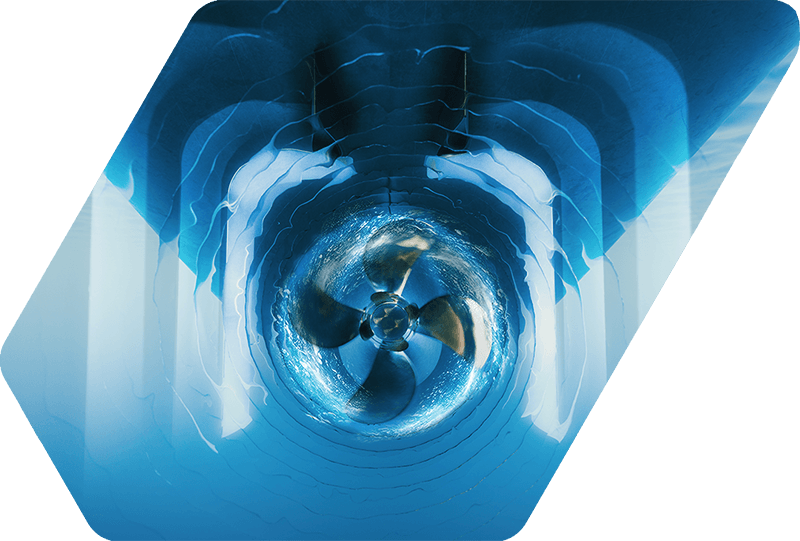
Gate Rudder is designed to be integrated into the vessel’s propulsion concept from the outset. Its performance relies on a propeller specifically designed together with the twin rudder foils, enabling controlled interaction between thrust generation and steering forces.
While Gate Rudder can technically be installed on existing vessels, the full performance and economic benefits are typically realised when the concept is incorporated into a newbuild design, where hull form, propulsion layout, and steering system can be optimised as a whole.
When Gate Rudder is integrated as part of the original vessel design, it can enable outcomes that are difficult to achieve with conventional rudder arrangements alone:
The realised benefits depend on vessel type, operational profile, and the overall propulsion concept – which is why the greatest impact is achieved when Gate Rudder is evaluated early in vessel design. In some applications, vessels equipped with Gate Rudder have reported fuel savings of up to 20%, alongside improvements in manoeuvrability and operational performance.
The resulting reduction in fuel consumption varies depending on vessel type, operating profile, and the reference propulsion and rudder configuration.
Gate Rudder consists of two high lift rudder foils positioned on either side of the propeller. Unlike conventional rudders located directly in the complex propeller slipstream, the foils operate in a controlled flow.
During transit, the rudder foils can rotate to adjust hydrodynamic loading, contributing to thrust performance. During manoeuvring, the foils function as a thrust‑directing system, allowing thrust to be redirected for rapid course changes and enhanced control.
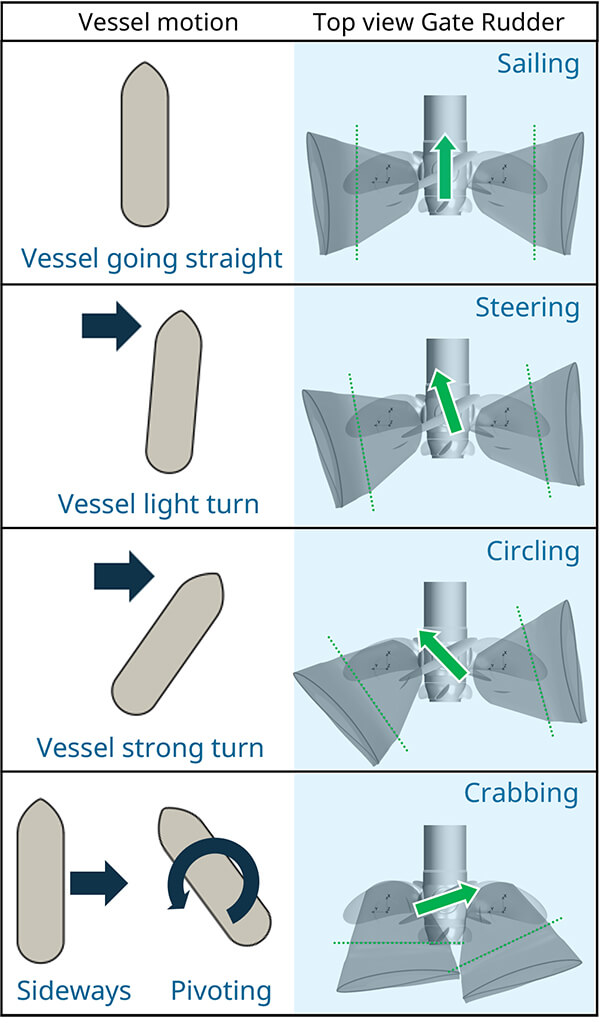
Gate Rudder operates in different modes – contributing to propulsion during transit and directing thrust during manoeuvring to improve control and responsiveness.
Gate Rudder is typically evaluated for newbuild vessels where:
The concept is primarily applied to single screw vessels, with suitability determined through vessel specific design evaluation.
Gate Rudder forms part of Wärtsilä’s broader approach to integrated propulsion design, where propellers, steering systems, and overall vessel performance are evaluated and optimised together – not one by one.
This system‑level perspective helps designers and vessel owners assess trade‑offs early, reduce redesign risk, and select propulsion concepts that deliver efficient and robust performance over the vessel’s operational lifetime.
Gate Rudder is one approach to improving efficiency and manoeuvrability in newbuild projects. Explore the Energy Efficiency page to see how propulsion concepts, hybrid systems, operational improvements and other solutions contribute to vessel performance across the lifecycle.
Wärtsilä specialists can support early‑phase design evaluations to assess how different propulsion and steering concepts perform for specific vessel types and operating profiles.