Dennis Voegele, Senior Product Manager, Software Product Management, Wärtsilä Energy Storage
As power grids transition to clean energy, they face a hidden vulnerability: the loss of traditional inertia that kept grid frequencies stable. Synthetic inertia has emerged as a “seatbelt” that can cushion sudden oscillations in supply and demand, preventing blackouts and keeping the lights on.
For decades, grid stability was implicitly guaranteed by the physics of large power plants. Inside a coal, gas, or nuclear plant, massive turbines and generators rotate in sync with the grid frequency, which is why they are known as synchronous generators. Depending on the grid, this is typically a frequency of 50 or 60 Hz, or 50 or 60 cycles per second. This spinning equipment carries kinetic energy – called mechanical inertia – which refers to an object’s inherent tendency to stay at rest or remain in motion. If a big generator trips offline or a sudden spike in demand hits, the momentum of all those heavy rotors would automatically slow the frequency decline, keeping the grid stable for a few precious seconds. In essence, inertia acts like a car’s locking seatbelt, keeping the passenger safe from abrupt bumps in the road.

Why does this matter? Grid frequency works in delicate precision, balancing supply and demand. If generation briefly falls short of consumption or vice versa, frequency will drop or spike respectively. Inertia provides an instant and critical response. Spinning generators either slow down slightly while their rotational energy injects power to prop up frequency or speed up to absorb the excess.
This buffer gives
grid operators a short window (typically a few seconds) to call upon other
resources before frequency gets too out of balance.
So, what’s changed? This tool worked well for the grid
historically. But, as we shift to an electricity system powered by renewables,
this implicit stability has been in decline. Solar and wind do not have the
same mechanical inertia that’s inherent to turbines of thermal plants.
You’re probably
thinking: don’t wind farms have plenty of turbines? Can’t they fill the gap?
While wind turbines
do spin, modern wind and solar generators interface through power electronics
(inverters) that decouple their motion from grid frequency. Unlike the turbines
we discussed earlier locked at 50-60 Hz with the grid, a wind turbine’s blades
can speed up or slow down with the breeze while converters electronically
produce power. This yields little to no inherent inertia contribution to the
grid (unless equipped with synthetic inertia capabilities themselves). Solar PV
has no moving parts at all, so it contributes no inertia.
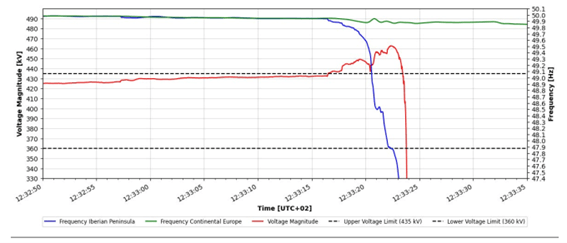
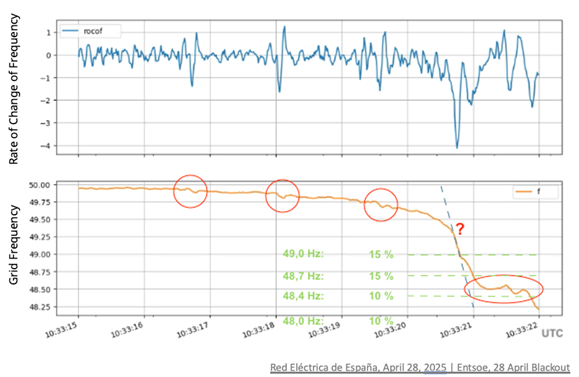
Image caption: The frequency and voltage in Spain and the rest of Europe on the day of the Iberian Peninsula Blackout. Source: ICS Investigation Expert Panel Factual Report, 2025
Grid failures are
incredibly dangerous. It doesn’t only mean the lights go out; outages makes
providing vital services extremely difficult—from keeping hospitals
functioning, streets safe, to maintaining heating and cooling systems that can
mean life or death. They also lead to significant monetary losses as delicate
equipment can be damaged by grid instability. On April 28, 2025, the Iberian
Peninsula experienced a worst-case scenario grid event: the grid went dark for over
55 million people, and it all started within seconds of the first generator
tripping offline.
So, what went wrong? The
grid was missing its seatbelt, meaning, sufficient inertia to maintain
frequency on the grid. This grid failure was a wake-up call for Portugal, which
has since committed 466 million euro to enhance grid management and buffer the renewable-heavy grid with
energy storage.
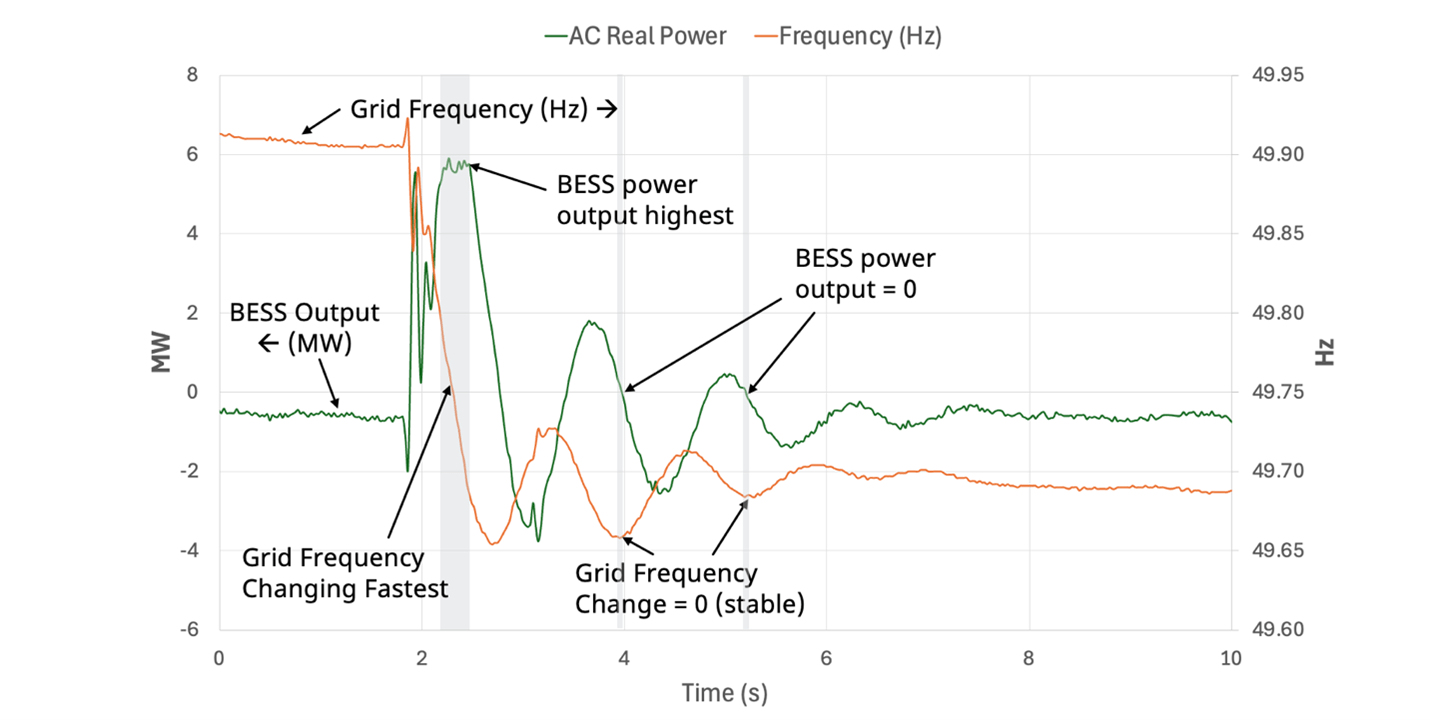
Image: A grid
frequency event where battery energy storage systems (BESS) step in within
milliseconds after a grid frequency event to maintain stability.
On grids with high percentages of renewable
generation, large-scale battery energy storage systems are emerging as the key
enabler of synthetic inertia. Batteries are uniquely suited for this role
because they can both inject power (discharge) or absorb power (charge) almost
instantly on command. This bidirectional capability means a battery can play
the part of a spinning generator’s inertia in either scenario—shortfall or
surplus.
When inertia was abundant, this was a service
that grid operators took for granted. Now, this fast response adds considerable
value to the grid, thereby creating a financial incentive for grid operators to
have more, and battery owners to profit.
In the UK, the
National Grid’s Stability Pathfinder programme is a prime example of this
approach in action. Under this scheme, companies are rewarded for providing
services like synthetic inertia and short-circuit current capabilities, which are
helping keep the system stable as coal plants retire. Zenobē’s system in Blackhillock, Scotland was one of the first of these projects. When it
went live in March 2025, it was the first in the world to offer true synthetic
inertia at that scale to a national grid operator. In doing so, it is helping
replace the inertia once provided by dirtier generation sources, ensuring
renewable power can flow without destabilising the grid.
This approach isn’t
specific to the UK either: Australia is also moving in this direction by
leaning on large-scale batteries and adding grid-forming capabilities in many
new storage projects. The marketplace for fast frequency response in Australia
means battery owners can earn money for stability services that help maintain
the 50 Hz grid frequency. This is a win-win-win: grid operators get the
reliability they need, storage developers are paid for their contribution, and Australians
have a cleaner, yet still reliable, grid.
We’ve now seen a major blackout caused by too
little inertia. And, while they don’t make it into the headlines, we’ve also
seen big batteries avert disasters by maintaining the grid frequency.
Around the world, grid operators are waking up to the need for synthetic inertia
as renewable penetration grows, opening a new revenue stream for battery operators.
Looking forward, we expect BESS plants using
grid-forming inverters to become a major contributor to grid stability. By
operating in grid-forming mode, these systems can respond even faster, help
blackstart the grid, and act as backup power for local communities.
As we enter a new era of power, one that is
more capacity strained, decentralised, and dependent on renewable energy,
stability becomes even more critical. Synthetic inertia is the hidden seatbelt
that will make it possible.
Once every six weeks, you will get the top picks – the latest and the greatest pieces – from this Insights channel by email.