
The debate about flexibility is often framed as a technology choice. I think that misses the real issue. As power systems add more renewables and retire inflexible legacy assets, the question is not whether engine power plants or batteries provide the only solution. The real question is whether market design is finally starting to reward the flexibility the grid actually needs.
Why this matters now
Europe’s power system needs flexible assets to balance the system, support higher shares of renewables, replace inflexible legacy capacity, and maintain reliable, low-carbon electricity. This is becoming more urgent: according to ENTSO-E, the need for flexible services is expected to double by 2033, and flexible gas technology is expected to play a major role, with an estimated 60 GW required by 2035. That is why flexibility is no longer a nice-to-have. It is becoming a system requirement.
But technology is only part of the story. Market design matters just as much. In Europe, 15-minute market time units are creating sharper value signals for flexible assets. For investors, that matters because shorter intervals do not just change dispatch. They change what an asset can earn. For grid operators, that matters because shorter intervals do not just change dispatch. They change the ability to manage variability.
What changes in a 15-minute market
A 60-minute market provides 24 signals a day. A 15-minute market provides 96. Those additional intervals reveal more opportunities to create value and make it easier to reward flexibility in real time. In practical terms, they uncover three distinct roles: sub-hourly arbitrage, multi-hour dispatch, and system stability.
No single technology can deliver all three roles equally well at the same time. That is why engine power plants and battery energy storage systems (BESS) are complementary assets. Engine power plants combine fast start with long duration and the ability to provide grid services. BESS excels in shorter instances and near-instant response. Together, they cover most of what the system needs.
Using 2023 market data, Wärtsilä modelled 15-minute markets in Germany and Finland to assess how engine power plants and BESS would perform under shorter intervals. What became very clear, was that both technologies are needed – and that shorter intervals unlock greater value for each of them compared to 60-minute intervals.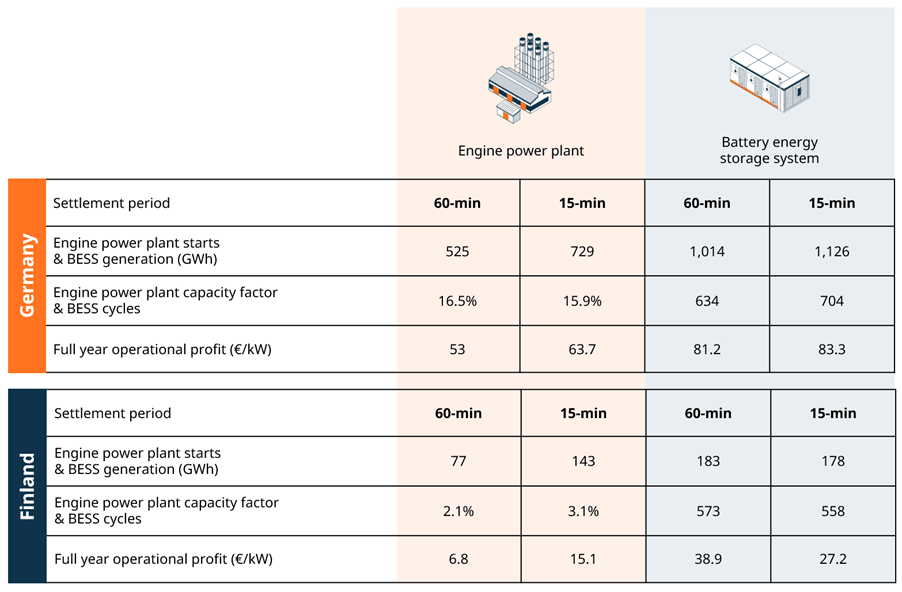
What the numbers tell us
For engine power plants, the impact is clear: the sharper the market signal, the more values investors can capture. In Germany, moving from 60-minute to 15-minute intervals increased starts from 525 to 729, which is nearly 40% more. In Finland, starts rose from 77 to 143, which is an 85% increase. What matters here is not simply more activity. Capacity factors remained broadly stable, decreasing slightly in Germany and increasing slightly in Finland. In other words, engines were able to provide more flexibility without a proportional increase in running hours.
BESS also benefits, although the pattern is more market-specific. In Germany, generation increased from 1,014 GWh to 1,126 GWh and cycles rose from 634 to 704, showing higher utilisation in a 15-minute market. In Finland, the picture was different: generation fell slightly from 183 GWh to 178 GWh and cycles declined from 573 to 558. The broader point is that shorter intervals still create more opportunities for grid services, but the commercial outcome depends on the underlying price dynamics in each market.
The profit story is even more telling. For engine power plants, annual operational profit increased by 20% in Germany and by 122% in Finland, driven by higher capture prices. For BESS, profits increased modestly in Germany by 2.5%, but fell by 30% in Finland due to lower pricing spreads seen throughout the back-casting scenario. Shorter intervals create more ways to monetise volatility, but they do not lift every technology in every market equally. That is exactly why a one-technology view of flexibility is too narrow.
The real insight: flexibility is a portfolio, not a product
When I look at these results, I see a strong case and requirement for both technologies. Engine power plants can provide sub-hourly arbitrage and sustained multi-hour dispatch, particularly in the morning and evening and in winter periods when renewable output is lower. BESS can provide sub-hourly arbitrage as well, but also near-instant stability services and sub-second response. These are not interchangeable roles. They are different layers of flexibility.
That matters for policymakers as much as it does for investors. From a system perspective, both technologies are needed. BESS brings sub-second response, zero-emission operation, and grid-forming services. Engine power plants bring fast response, long-duration generation, voltage control, black-start capability, and short-circuit services. If the goal is resilience, reliability and deeper renewable integration, choosing only one type of flexibility is the wrong design logic.
The nuance we should not ignore
It is important to note that these results come from back-casting based on 2023 market data in Germany and Finland, and the scenario includes only day-ahead revenues. The model does not yet include ancillary services revenues. So while the findings present a view into the benefits of 15-minute markets, they should be read as directional evidence of market value under shorter intervals, not as the final word on every revenue stream.
That nuance does not weaken the argument. If anything, it sharpens it. A market that exposes flexibility more clearly should reward assets for the services they provide, not for their technology label or installed capacity alone. The more granular the signal, the easier it becomes to recognise real system value.
Reward flexibility, not technology
For me, that is the key takeaway. Policy and market design should reward the range and timing of services an asset can provide. That means greater consistency across markets in how rules are implemented and how flexibility is remunerated. Without that consistency, investment signals stay blurred, and the system moves slower than it needs to.
And 15-minute intervals are only the beginning. 5-minute dispatch intervals are already being used in Australia and the United States, and shorter intervals is the next step in sharpening market signals in Europe and improving visibility of system variability. The shorter the interval, the clearer the signal. And the clearer the signal, the better our chances of building a more resilient and efficient European power system – one that gives investors confidence and gives the grid the full flexibility it needs.
Once every six weeks, you will get the top picks – the latest and the greatest pieces – from this Insights channel by email.