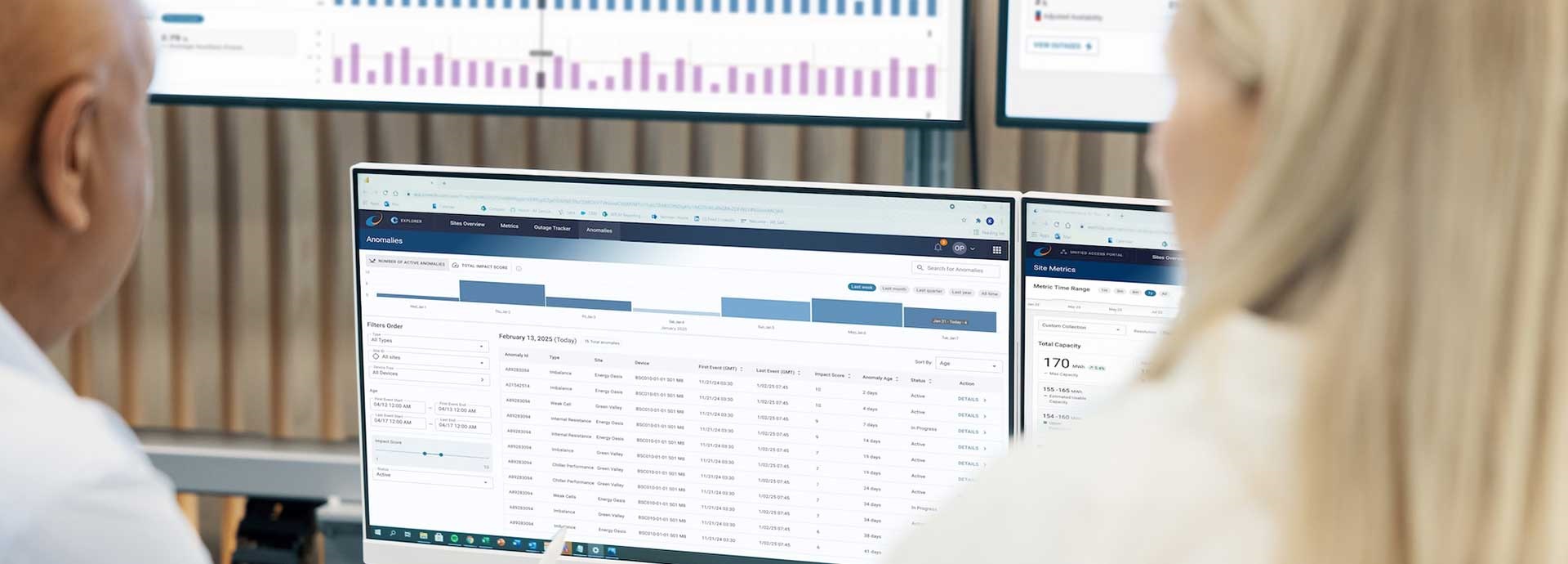
Last week, we hosted the webinar "Demystifying the BESS performance metrics that matter most: SoC, SoH, cell imbalance, and RTE" with Energy Storage News. After a lively and insightful conversation, Andrea and Steve were met with a flood of questions—roughly four dozen. It’s clear this topic of this session struck a chord, and the audience was eager to dig deeper.
While we couldn’t get to every question during the session, Andrea and Steve circled back to answer the most frequently questions below.
Missed the webinar? Watch a replay on demand here.
++++++++++
Is state-of-charge (SoC) calibration the same as cell balancing? How often should they occur, and can they be done through an EMS?
SoC calibration and the creation of a cell balancing plan are different functions, but they do occur at the same time. When a low SoC is reached and rested at, the Wärtsilä Battery Management System (BMS) calibrates the SoC for each cell, notes any differences in SoC cell to cell, and creates the cell balancing plan based on those differences. The cell balancing plan is executed on slowly, in the background, during rest and operations.
The GEMS Power Plant Controller (PPC) performs automated calibrations, meaning that the operation doesn’t need to take any action for a calibration to be done. The operation sets a calibration cadence (every two weeks is the default), and the PPC will ensure that each string is calibrated at that frequency or greater, as natural calibrations allow.
++++++++++
It’s well known that cell balancing involves discharging energy which can lead to temperature rise. How do you make sure the temperature doesn’t rise substantially and lead to thermal runaway?
At Wärtsilä, we take a two-tiered approach to managing safety and preventing thermal runaway such that cell imbalance cannot lead to thermal runaway.
First, we recognise that passive balancing can generate heat because it discharges through a resistor to bring cells back into balance. We design our system such that, even maximum balancing current happening indefinitely cannot lead to a significant enough temperature rise to pose a thermal risk.
Second, the Wärtsilä BMS continuously monitors the temperature of cells, boards, and critical points within the BESS. This proactive monitoring ensures that any thermal anomaly is addressed immediately – turning off balancing, derating power, and potentially turning up the chiller – long before it can lead to degradation or safety concerns.
++++++++++
How does RTE factor into this?
Round Trip Efficiency (RTE) measures the ratio of energy output to energy input at the point of interconnection with the grid. This metric is critical for asset operators because it directly impacts the cost of charging and the commitment to deliver energy back to the grid.
At Wärtsilä, we aim for the highest possible RTE and continuously monitor it through our GEMS Pulse platform. Pulse tracks RTE and other efficiency metrics over time, helping identify trends or anomalies that may require investigation.
Since RTE is often part of long-term service agreements (LTSA), understanding deviations—whether lower or higher than expected—is essential. Our platform provides insights into root causes, ensuring operators can maintain performance commitments and optimise profitability.
++++++++++
Are state of charge and depth of discharge different (other than being opposite measures)? Is there a reason to track both?
State of charge (SoC) is a calculation that estimates how much energy is left in a given battery cell, module, or string. Most operations care about instantaneous SoC, and few track it over time to get an average or resting SoC.
Depth of discharge (DoD) tracks the delta of maximum SoC and minimum SoC during a discharge cycle. Tracking DoD through a tool like GEMS Pulse helps refine predictions for state of health (SoH) and how it changes in response to operational use. In general, a higher DoD values will lead to increased degradation. In the scenario generation tool in GEMS Pulse, DoD is used to help an operation strike the right balance between maximising revenue and maximising SoH over the asset’s lifetime.
++++++++++
Lately, we have been seeing that the utility/offtaker doesn't allow operation beyond the contractual energy, and with systems having massive overbuilds, we don't operate from 0-100% SoC range. How will the PPC perform calibration if that's the case?
Even if the operation doesn’t typically reach the low-SoC ranges where calibration occurs (due to overbuild, primarily performing ancillary services, etc.), the GEMS PPC will use autocalibration to rotate through strings for calibration, temporarily taking the string out of operations, steering it to the calibration range, performing calibration, and then steering it back up to the SoC of the full system to rejoin market participation.
Not using the full SoC range is common in BESS, and can be due to a variety of factors, either intentional (like primarily performing ancillary services), or unintentional, like overbuild. In the case of overbuilt sites, GEMS Pulse can generate options for effectively monetising that asset.
++++++++++
Can you share more about GEMS Pulse?
GEMS Pulse is a battery analytics solution that helps optimise the long-term value of your product by working closely with your hardware. Pulse can help unlock additional capacity by managing imbalance and weak cells, optimising operations through proactive maintenance, and providing insight into long-term degradation trends.
Learn more about GEMS Pulse by exploring our press release or solution sheet.
Once every six weeks, you will get the top picks – the latest and the greatest pieces – from this Insights channel by email.