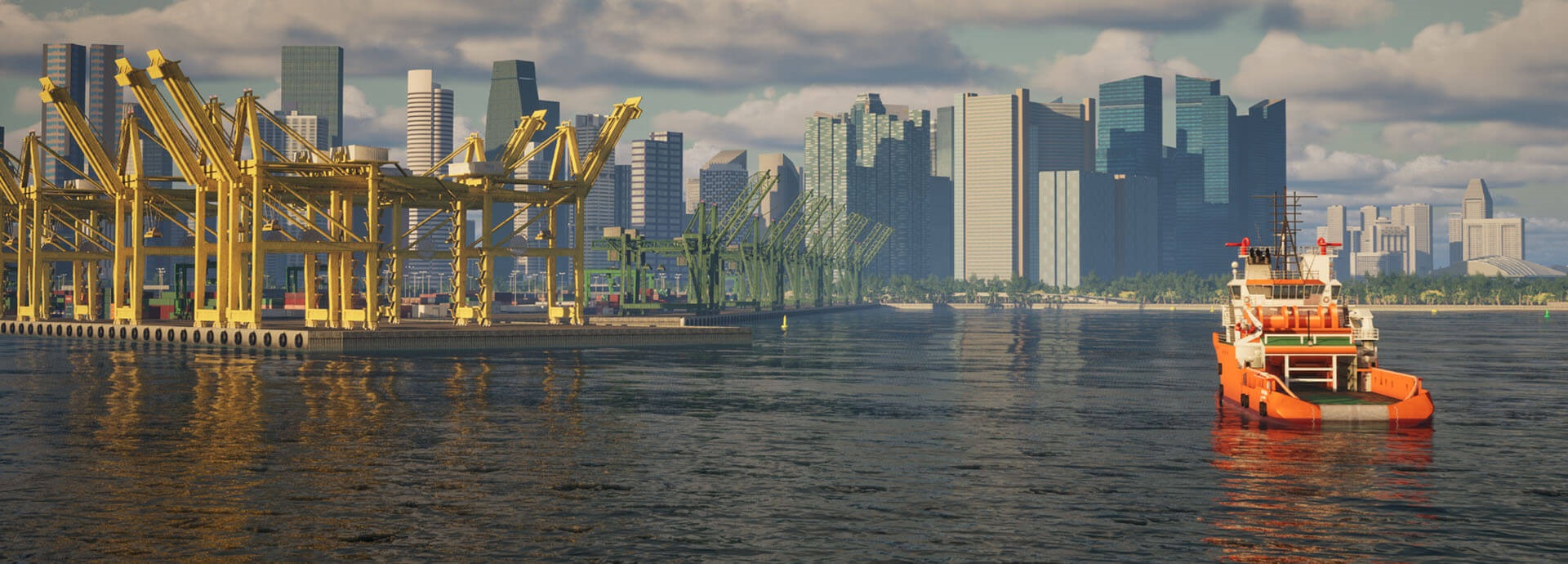
The challenges faced by maritime crews on a vessel bridge include difficulties with visibility caused by weather and the level of light along with the need to monitor vessel traffic and port layouts carefully.
Maritime crews must make critical navigational and operational decisions in environments that are visually complex. They need to practice for situations such as:
These kinds of situations are tricky for crews. Crews need to make critical decisions under pressure, often with unclear or incomplete information. In situations like these, even the smallest misjudgements can quickly escalate into serious safety incidents.
Photorealistic simulation is the most effective training solution to ensure safe and efficient bridge operations. This is because it can reproduce an accurate environment, complete with visual and audio cues that crews rely on when they are making decisions on a real ship bridge.
To be effective, simulator training should create realistic situations in the following areas:
Modern visual engines allow training programmes to accurately replicate the environmental cues that influence real-world maritime decision-making. These include dynamic lighting, evolving weather systems, realistic material reflectance and contextual audio such as noise from wind, engines and nearby maritime traffic.
Together, these audio and visual cues allow crews to rehearse demanding situations in a way that closely reflects real bridge operations.
The main benefit of photo‑realistic simulation is that it reduces risk by providing trainees with highly immersive and realistic training scenarios. The higher the level of immersion, the more effective the training.
Photorealistic simulation brings clear operational benefits for training organisations and crews. For example, hyper‑realistic simulation:
Photorealistic simulation also simplifies the training process. Training can be carried out in a controlled environment in a shorter amount of time compared to having a crew on a real vessel.
A high level of visual realism helps trainee mariners and experienced crews to:
In this way, when crews face similar conditions at sea, they can make safe, effective decisions with confidence.
For instructors, photorealistic simulation also improves how they deliver training. Realistic visuals and real-time responsiveness make it easier to run complex scenarios. Training exercises can also be adapted on the fly without technical interruptions. This allows instructors to focus on coaching decision making and situational awareness instead of being tied up with managing the simulator.
Modern simulation environments also act as an attraction for young prospective seafarers who are used to photorealistic, ultra-responsive gaming platforms. Training platforms that offer the same level of visual and technical sophistication make maritime training more appealing, which helps the maritime industry compete for top talent in a challenging recruitment landscape.
To ensure realistic simulation, the simulator relies on a visualisation engine. Leading visualisation engines provide the following benefits for trainees:
Here is a short video that shows examples of maritime visualisation environments built using modern gaming technology:
A modern bridge simulation platform is an example of a photorealistic training solution. To meet the needs of training academies, Wärtsilä has updated its NTPRO bridge and ship handling simulator.
The latest version, Wärtsilä NTPRO 7, brings a new level of realism and future‑ready navigation training to maritime education. The platform’s visualisation and sound systems are powered by Unreal Engine 5 (UE5) and are based on mathematical modelling developed over 30 years. Built to support S‑100 compliant workflows, Wärtsilä NTPRO 7 offers:
Wärtsilä NTPRO 7 is designed to help attract trainees, improve learning outcomes and keep up with evolving standards. With NTPRO 7, maritime training centres can:
Wärtsilä NTPRO 7 is built on the idea that real-world visual cues are critical for effective maritime training. Mariners need to rely on subtle details in lighting, motion, visibility and surroundings to make the best decisions. Simulators that can reproduce these small but important cues enable crews to train in environments that closely mirror operational reality, making learning more effective.
Discover how Wärtsilä NTPRO 7 can help your maritime training centre train safer, more competent crews. Learn more
Once every six weeks, you will get the top picks – the latest and the greatest pieces – from this Insights channel by email.