


Wärtsilä’s analysis shows that Polish district heating operators could achieve more efficient cost structures through a more optimal choice of generating technology.
Modern, flexible combined heat and power plants can actively participate in dynamic electricity markets, strengthening operators’ revenue base.
High electrical efficiency in combined heat and power engines is critical: it delivers significantly lower heat prices and faster returns.
According to the analysis, choosing a less efficient heat and power generation technology in an area with a population of 50,000, could result in additional costs of nearly EUR 1.1 million per year.
Technology group Wärtsilä’s analysis indicates that the district heating system in Poland could achieve more efficient cost structures through a more optimal choice of generating technology. The operators could achieve this by raising the importance of electricity production to that of heat generation. This could result in strengthened revenue base for district heating operators, which in turn could enable greater flexibility in how the end-user pricing is structured.
Combined heat and power (CHP), or cogeneration, technology generates heat and electricity simultaneously in a single, energy efficient process. Most of the heat used in Europe’s heating and cooling networks is derived from this technology. However, in Polish cogeneration plants, heat production has been the priority for many years, while the generated electricity has been treated as a by-product. Typically, the electricity produced has been considered a ‘bonus’ and sold at a fixed price, without having any significant impact on the energy market.
The reason for this is that most cogeneration plants were not designed to adapt to frequent switching on and off, nor to respond quickly to changes in electricity prices. At the same time, the core mission for district heating operators has been to supply heat to residents, with little consideration given to delivering value through electricity production.
“For a long time, district heating systems operated ‘alongside’ the electricity market, selling electricity mainly at fixed prices based on long-term contracts and with a subtle link to market dynamics. This is now changing. Across Europe, heating plants are increasingly becoming active participants in the modern energy system, supporting flexibility and responding to market signals rather than acting solely as heat suppliers,” says Krzysztof Łokaj, Manager for Market Development in Europe and Africa at Wärtsilä Energy.
The energy market’s paradigm shift
The increasing adoption of energy from renewable sources, notably solar and wind, is creating fluctuations in electricity production, thus influencing prices. This paradigm shift away from traditional system operation means that production flexibility is needed to be able to respond to rapidly changing situations. The change is, however, also an opportunity for modern cogeneration plants.
By embracing flexible technologies that allow increases or decreases in output, plants can support energy systems, rather than just heat homes. When weather conditions are not favourable for renewable generation, cogeneration plants with engines can be switched on and off as needed and can respond to changes in electricity demand. Thus, a modern plant should not only heat homes but also earn money by producing electricity when it is most expensive. The combination of modern electrical technologies with efficient engines in cogeneration plants allows cities to provide heat in a reliable and affordable manner. At the same time, district heating operators can operate in a financially stable way.
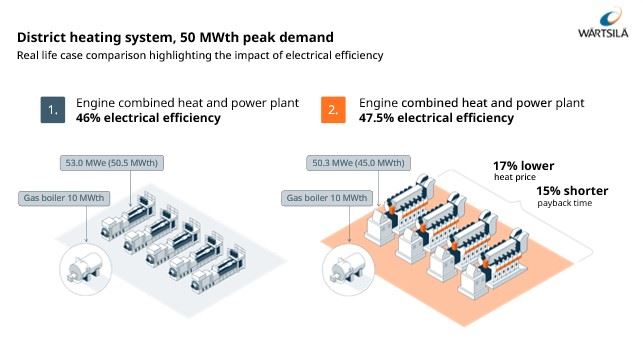
However, some engines are better at converting fuel into electricity than others. As a result, they produce more electricity that can be sold for the same amount of fuel. This, in turn, helps gain more revenue and thus keep heat prices stable, while reducing the investment payback time. The Wärtsilä analysis includes details of the financial benefits gained from utilising high efficiency engines. Using Plexos modelling, Wärtsilä Energy analysed a 50 MWth district heating system under two combined heat and power efficiency scenarios. The results show that higher electrical efficiency delivers significantly lower heat prices and faster returns. The analysis was conducted in February–March 2026.
The move to flexibility
In modern combined heat and power plants, which typically operate with flexible gas engines, both electricity and heat generation are considered equally important. The engines can quickly adjust their power to the current heat requirements or maximise electricity production during periods of high demand. To maximise profits, and in turn reduce heat prices for consumers, by participating in dynamic electricity markets, state-of-the-art engines with the highest electrical efficiency are required.
The impact of increasing levels of renewable generation is that the fluctuations in supply need to be balanced. Traditional baseload power generators start suffering economic losses during the low-price periods as they cannot flexibly follow the price signals.
“This change opens opportunities for district heating operators that use truly flexible and efficient technologies. By using high efficiency engines, combined heat and power plants can become the main source of flexibility for power grids,” emphasises Krzysztof Łokaj.
Combined heat and power plants can generate electricity during periods of high heat demand, but also when renewable generation is not sufficient due to changing weather conditions. Both supply and demand are therefore variable. Combined heat and power plants running on engines can start up and shut down as many times a day as needed, capture price spikes and avoid operating during periods of low or negative prices. This makes them ideal for dynamic heating systems and volatile market environments.
Krzysztof Łokaj notes: “Polish district heating operators sometimes only require the total combined efficiency of a combined heat and power plant, and even prioritise thermal efficiency over electrical efficiency. In our opinion, this is the wrong approach, especially for public utilities, which should strive to achieve the highest possible profitability to ultimately lower heat prices for consumers. According to our analysis, choosing a less efficient heat and power generation technology in an area with a population of 50,000, could result in additional costs of nearly EUR 1.1 million per year.”
Wärtsilä's analysis concludes that to generate significant revenues, Polish district heating operators need to choose the more efficient technologies for their future operations.
Media contact for more information on this release:
Katri Pehkonen
Communications Manager
Wärtsilä Energy
Mob: +358 50 591 6180
katri.pehkonen@wartsila.com
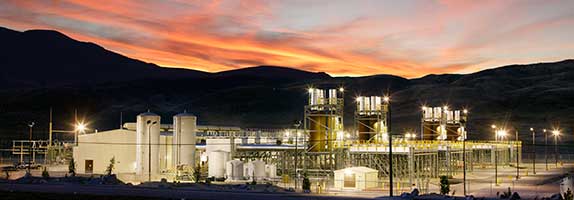
Image caption: Wärtsilä analysis highlights how optimal technology could unlock more affordable district heating for Polish consumers. © Wärtsilä Corporation
All Wärtsilä releases are available at www.wartsila.com/media/news-releases and at news.cision.com/wartsila-corporation where also the images can be downloaded. Use of the image(s) is allowed only in connection with the contents of this press release. Wärtsilä images are available at www.wartsila.com/media/image-bank.
Wärtsilä Energy in brief
Wärtsilä Energy is at the forefront of the transition towards a 100% renewable energy future. We help our customers and the power sector to accelerate their decarbonisation journeys through our market-leading technologies and power system expertise. Our solutions include flexible engine power plants, energy storage and optimisation technology, and services for the whole lifecycle of our installations. Our engines are future-proof and can run on sustainable fuels. Our track record comprises 81 GW of power plant capacity and over 130 energy storage installations in 180 countries around the world. About 35% of our operating installed base is under service agreements.
www.wartsila.com/energy
Wärtsilä in brief
Wärtsilä is a global leader in innovative technologies and lifecycle solutions for the marine and energy markets. We emphasise innovation in sustainable technology and services to help our customers continuously improve environmental and economic performance. Our dedicated and passionate team of 17,900 professionals in 199 locations in 78 countries shape the decarbonisation transformation of our industries across the globe. In 2025, Wärtsilä’s net sales totalled EUR 6.9 billion. Wärtsilä is listed on Nasdaq Helsinki.
www.wartsila.com